12 February 2026
Nordhausen, 12 February 2026 - How can the energy transition succeed in practice? This question is the focus of the 9th Regenerative Energy Technology Conference (RET.Con), which will take place at Nordhausen University of Applied Sciences from 12 to 13 February. For around two days, experts from research and industry will be discussing new technological developments and the necessary networking of modern energy systems.
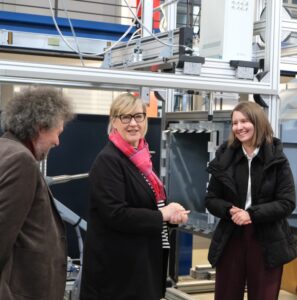
1. during the 9th RET.Con, M.Eng. Christin Rothe (Nordhausen University of Applied Sciences) explains to State Secretary Karin Arndt how the Göttingen-type wind tunnel works.
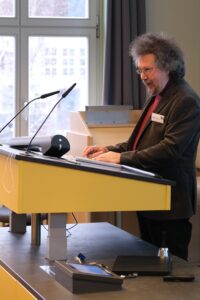
2 Dr Maria Nuschke (TenneT) talks about the „Edison era in the transmission grid“ and the transformation through high-voltage direct current transmission (HVDC)
3 Prof Dr Viktor Wesselak opens the 9th RET.Con 2026 at Nordhausen University of Applied Sciences
(Photos: Tim Rückschloß)
RET.Con traditionally takes place once a year and is dedicated to the central challenges of the energy transition. The RET.Con conference for renewable energy technology brings together companies, trade associations and research institutions to present the latest developments and research findings in the field of renewable energies and discuss them in a scientific context.
Thuringia's State Secretary for Energy, Karin Arndt, will provide the political framework for the expert talks with a welcoming address at the opening. She is standing in for Energy Minister Kummer, who recalled the current challenge in a written greeting:
„With a future energy supply that is secure, socially balanced and environmentally friendly, we are taking care of our social prosperity together. We have learned from the mistakes of the past: our energy supply should be decentralised, avoid serious interventions such as the demolition of entire villages in open-cast mines and avoid incalculable follow-up costs such as those associated with nuclear energy or coal mining. This type of energy supply enables financial gains to be made much more in regions with biomass, solar, wind and geothermal energy. The changes will succeed where citizens, local authorities and industry, research and society pull together. Conferences such as the RET.Con in Nordhausen help to bring experts together to learn from the best examples and most innovative solutions. I wish all participants every success in this endeavour,“ said Energy Minister Kummer.
The conference will start with a keynote speech by Dr Maria Nuschke (TenneT). Under the title „The Edison era in the transmission grid?“, she will analyse the current grid expansion. As an expert from a transmission system operator, she emphasised that the energy transition requires a fundamental transformation of the infrastructure in order to build a bridge from historical grid structures to intelligent system integration.
„The energy transition requires a technically and economically optimised transformation of our energy infrastructure. While we have been consistently optimising the alternating current grid since 2010 on the basis of the grid development plan, the expansion of offshore wind energy means that the focus is increasingly shifting to high-voltage direct current transmission lines and the connection of onshore wind energy. By maximising the utilisation of the grid connection systems and the future networking of interconnectors on land, we are increasing efficiency and at the same time reducing grid costs for the general public,“ says Dr Maria Nuschke.
The scientific programme is divided into seven sessions covering the spectrum of modern energy systems:
- Energy system modelling: This year's focus is on analysing time series and integrating flexibility into energy system models.
- Building energy supply: The focus here is on control concepts and operating experience with the interaction of different components.
- Sector coupling: Strategies for integrating sector coupling technologies and wood waste into energy infrastructures will be discussed.
- Energy storage: The sessions will cover current developments in battery research, bidirectional charging processes and innovative measurement methods for ice storage systems.
- Heat transition in Thuringia: Regionally focused articles analyse the potential of energy-efficient building refurbishment and local heat demand profiles.
Networking with the open source community
The conference was flanked by the oemof user meeting. oemof (Open Energy Modelling Framework) is a modular open source software environment for modelling and optimising energy systems. The association behind it promotes transparency and openness in energy science (open science). The meeting focussed on the further technical development of the framework through tutorials and user presentations.
Mutual participation in the presentations at both events enables a direct exchange between the developers of open source modelling tools and users from the energy industry.





Study Service Centre
+49 3631 420-222
House 18, Level 1, Room 18.0105