


 Photo: Tina Bergknapp (Nordhausen University of Applied Sciences)
Prof Dr Sabine Seibold-Freund
Equal Opportunities and Family Officer, Professor
+49 3631 420-573
+49 3631 420-817
Building 18, Room 18.0407
In accordance with the Thuringian Equal Opportunities Act, Nordhausen University of Applied Sciences contributes to the constitutionally guaranteed equal rights of women and men. The aim is to realise equal participation of women and men of all status groups at the university and to ensure equal development opportunities for women and men. The advancement of women is seen as an integral part of personnel development in order to eliminate structurally induced disadvantages for women and to further improve the working and study situation of women at the university. In particular, the aim is to increase the proportion of women through suitable organisational, personnel and training measures in those areas in which women are underrepresented. Nordhausen University of Applied Sciences is committed to making it easier for its employees to combine work and family life. The aforementioned objectives expressly apply equally to women and men.
In accordance with Section 4 of the Thuringian Equal Opportunities Act (ThürGleichG) and Section 6 (1) sentence 2 of the Thuringian Higher Education Act (ThürHG), each department with at least 50 employees draws up an equal opportunities plan for six years with the early involvement of the Equal Opportunities Officer. It must be adjusted after three years based on the statistics of current developments.
The current Gender Equality Plan for the years 2023-2025 is based on the cut-off date 30 June 2023 and was approved by the University Assembly of Nordhausen University of Applied Sciences. According to Section 2 ThürGleichG, the actual equality of women and men in all areas of public life is to be promoted and ensured through appropriate measures.
Women and men shall be promoted in accordance with this Act in order to achieve equality.
The aim of the funding is in particular
The equality plan includes, in particular, measures to promote equality between women and men, the compatibility of work and family life, including care and nursing, and to increase the proportion of women or men in areas in which they are underrepresented.
Nordhausen University of Applied Sciences has developed qualitative gender equality goals for a gender-equitable organisational and academic culture, which are set out in the Gender Equality Plan. HSN consistently anchors gender equality as a quality criterion in its guiding objectives and organisation. This raises awareness of implicit and explicit discrimination in order to strengthen the fairness and gender equality of existing structures.
The university also organises its promotion of young talent and personnel development in a gender-equitable manner in order to support young female academics on their academic career path and to keep the proportion of women stable across all academic qualification levels. This should also make it possible to reconcile science, studies and work with family responsibilities.
With the Gender Equality Plan, Nordhausen University of Applied Sciences is making a contribution to the constitutionally guaranteed equal rights of women and men. The aim is to realise equal participation of women and men of all status groups at the university and to ensure equal development opportunities for women and men. The advancement of women is seen as an integral part of personnel development in order to eliminate structurally induced disadvantages for women and to further improve the working and study situation of women at the university. In particular, the aim is to increase the proportion of women through suitable organisational, personnel and training measures in those areas in which women are underrepresented.
The CEWS1-The University Ranking by Gender Equality Aspects 2025 has been published and is available online at https://www.gesis.org/cews/cews-publikationen/cewspublik. The ranking is based on data from the official higher education statistics from 2023. The aim of the ranking is to continuously compare the performance of universities in terms of gender equality across Germany using quantitative indicators. The ranking thus complements other quality assurance instruments such as competitions (female professors programme), evaluations and certifications.
The CEWS has compiled the ranking every two years since 2003. Since its first publication, it has developed into an established instrument for quality assurance of gender equality at universities. With this edition, we are changing the methodology and adapting the ranking to changes in the gender equality policy debate and gender distribution at universities. In order to continue to incentivise efforts in gender equality policy, the ranking groups will in future be formed using threshold values and not quartiles as before. The threshold values give all universities the opportunity - and therefore an incentive - to be in the top group. Furthermore, the indicator on academic and artistic staff for universities will only be calculated for staff with doctorates. Despite these changes, the basic principles of the ranking remain the same - the complete survey of German universities, the use of official data from the Federal Statistical Office, the use of a set of indicators and the reference to the cascade principle. The methodology and its changes are explained in detail in the publication.
Nordhausen University of Applied Sciences has been endeavouring for years to increase the proportion of women in science, professorships and students in the STEM subjects. In the overall assessment of universities of applied sciences, HSN was able to establish itself in ranking group 2 (just behind top group 1 with 7 out of 8 criteria, page 12 CEWS). In the state ranking, however, Thuringia is only in the midfield (ranking group 7, see page 20 CEWS).
Even though the overall proportion of female students at the HSN is 50.77% (page 91 CEWS), there is still a need for development among students in the engineering faculty with a very low proportion of women (page 28 CEWS). This value is also in line with the student indicator according to the country ranking list, where Thuringia (page 104 CEWS) is in the last group (need for development). A country ranking for STEM subjects with a nationwide proportion of women below 40% is also cited (page 105 CEWS).
The development of academic staff is particularly positive: the proportion of women increased to 54.79% (2023) compared to 2018 with 51.92%. This puts HSN in the top group (page 66 and page 78 CEWS). This clearly shows that young female academics are sustainably supported at the HSN. In terms of the number of female professors, the HSN is in the front midfield with a ratio of 29.55% (page 72 CEWS). Nevertheless, a positive trend in the number of female professors can be observed at the HSN: In a comparison of the values of the current ranking (2023) with the last ranking (2018), HSN was able to increase the proportion of female professors from 20.41% to 29.55% - and can be found in the top group due to this increase (page 84 CEWS). Despite the small size of the university, the proportion of female doctoral students is 37.28% (page 97 CEWS).
The good result in the CEWS Ranking 2025 clearly shows that the extensive measures in HSN's gender equality policy (gender equality plan, gender equality concept, new appointment regulations) are successful. The ranking is aimed at all those in universities and politics who are interested in the quality and innovation potential of universities. A comparative look at performance in the area of gender equality policy is essential in order to introduce or continue effective measures for gender equality in science and research.
Photo: Tina Bergknapp (Nordhausen University of Applied Sciences)Equal Opportunities and Family Officer, Professor
+49 3631 420-573
+49 3631 420-817
Building 18, Room 18.0407
 Photo: Tina Bergknapp (Nordhausen University of Applied Sciences)
Employee, Deputy Equal Opportunities Officer
+49 3631 420-212
Building 14 Room 14.0001
Founded in 2013, the TKG is a joint academic institution of the Thuringian universities. It acts as a service centre for Thuringian universities to initiate, develop and consolidate equal opportunities measures and to inform, advise and network those active in equal opportunities. It regularly organises an exchange of information and experience between those active in equal opportunities, offers training courses on equal opportunities work and provides brochures and guidelines on this topic free of charge. Current events can be found at www.tkg-info.de/aktuell There is also a free newsletter that provides information about all offers (registration via: ).
The services offered by TKG include the Rowena Morse Mentoring Programme (RMMP) for female doctoral candidates in the final phase of their doctorate and postdocs in planning their individual career paths.
Every year the Prize: "Diversity meets science" for final theses with a gender and diversity perspective. Students from our university also regularly take part in this programme.
The TKG supports gender equality events at Thuringian universities in a variety of ways.
Since 2016, the Thuringian Coordination Centre for Science and Technology (ThüKo NWT) a working unit of the TKG. The aim is to increase the proportion of young women in technical and scientific degree programmes.
Among other things, the CampusThuringiaTourwhich gives schoolgirls interested in STEM subjects a week-long in-depth insight into Thuringia's universities. There are also regular Networking evenings ("MINT-Geflüster") and STEM mentoring projects with role models.
I have been supporting the TKG as a decentralised employee at our university. In this function I am Contact person for the coordination and implementation of TKG projects and measures at our university.
Supported by the TKG, events with exciting speakers took place at our university, for example on the topic of equal rights and parity with Prof. Dr Silke Laskowski and Dr Gabriele Andretta (former President of the Lower Saxony State Parliament) and on the "Mothers of the Basic Law" with Susanne Selbert. A staged reading shed light on the topic of sexual violence and (self-)justice. An exhibition with an accompanying programme on the topic of "Together against sexism" is currently being prepared. The next CampusThüringenTour is also coming up, which is being prepared and organised with great commitment by many helping hands at our university.
Prof. Dr Viola Sporleder-GebProfessor of Constitutional and Administrative Law

Internship officer, professor
+49 3631 420-548
Building 18, Room 18.0223
The person responsible for diversity supports Nordhausen University of Applied Sciences in taking into account the diversity of its employees and students and works in coordination with the university's Family and Equal Opportunities Officer.
The consideration of diversity is about, among other things Aspects such as origin, gender, religion or ideology, disability, age, gender identity or sexual orientation.
As a prelude, a Diversity Action Plan was drawn up for Nordhausen University of Applied Sciences, which specifies goals and measures to take diversity into account as well as measures to prevent and eliminate disadvantages.
The relevant interest groups (e.g. StuRa, Equal Opportunities Officer, Representative for Severely Disabled Students, Inclusion Officer and Staff Council) are involved in the further development and updating of this plan. It is also necessary to develop measures to prevent and remove obstacles that have a negative impact on the participation of students and staff. The latter should, for example, draw attention to discrimination and disadvantages with the interest groups and/or counselling services (student services, general student counselling, counselling services of the Studierendenwerk, etc.) as soon as they become aware of them.
The university must take diversity categories into account both with regard to recognising the needs of employees and students and with regard to preventing and eliminating discrimination (ThürHG §5 para. 7 and 8). The task within the scope of the diversity mandate is therefore to be carried out within the framework of Anti-discrimination and abstention is located here. Responsibilities within the scope of this task arise primarily from the provisions of the General Equal Treatment Act (AGG) and, in particular for the university sector, from the Thuringian Higher Education Act and the provisions of the United Nations Convention on the Rights of Persons with Disabilities.
In 2024, the German Rectors' Conference (HRK) adopted the resolution "On the way to more gender equality in appointments - voluntary commitment of German universities". The universities that are members of the HRK are thus committed to further reducing structural gender inequalities and achieving appropriate gender representation in professorships at universities. The resolution specifies concrete goals and fields of action as well as measures that can contribute to the realisation of an institutional cultural and structural change towards more gender equality at universities and have the character of a self-commitment.
For more gender equality in appointments, the HRK resolution recommends above all a more active recruitment of women in early academic career phases in order to expand the pool of female candidates for appointments.
Further measures include the establishment of more gender-equitable appointment procedures and remuneration structures as well as the institutionalisation of gender sensitisation. Consistent monitoring of these measures is also necessary in order to ensure that the objectives are realised.
The HSN has signed the voluntary commitment and will take further measures to enable an equal distribution of all genders in professorships at the HSN in the medium to long term.
Since February 2025, our university has been awarded the title "University with Strong Gender Equality" by the BMBF as part of the Female Professors Programme. This award confirms our commitment to equal opportunities and the targeted promotion of female academics. We create transparent career paths, strengthen early career researchers and remove barriers for women in science. In this way, we are shaping a university that promotes diversity and supports excellent talent.
Of the 34 universities across Germany that have so far been awarded the title of "University with Strong Gender Equality", three are in Thuringia - HSN is the only (specialised) university.

Minister of Science Christian Tischner emphasised:
"The successful performance of Thuringia's universities is an important sign in favour of equal opportunities and the promotion of women in science. The universities in the Free State are setting standards and proving that excellence and equality go hand in hand. I would particularly like to congratulate Nordhausen University of Applied Sciences on its outstanding achievement. Thuringia's universities must be well positioned in the international competition for the best female minds. The successes of our universities strengthen Thuringia as a centre of science in the long term."
News | Thuringian Ministry of Education, Science and Culture
Authors: Prof Dr Cordula Borbe, Prof Dr Sabrina Schramme
 Photo: Tina Bergknapp (Nordhausen University of Applied Sciences)
Diversity Officer, Professor
+49 3631 420-565
House 8, Room 118
Nordhausen University of Applied Sciences sees itself as a gender-equitable and family-conscious, cosmopolitan, inclusive and intercultural university. It stands for an image of people and society that combines diversity and equality. Nordhausen University of Applied Sciences emphasises cooperation based on trust and respectful and appreciative interaction. It is committed to ensuring that no person is disadvantaged on the basis of gender, ethnic or social origin, appearance, age, disability or illness, sexual orientation or gender identity, religion or ideology or marital status.
The General Equal Treatment Act (AGG) is a federal law that aims to prevent or eliminate such discrimination. Employees have the right to lodge a complaint with a specially established complaints office if they feel they have been discriminated against by their employer, superiors, other employees or third parties in connection with their employment relationship.
If you would like to report a case in which you believe you have been disadvantaged in the above sense, please contact the Nordhausen University of Applied Sciences Complaints Office informally by e-mail, telephone or in person. Your complaint will of course be treated with absolute confidentiality and discretion at all times.
You are currently viewing a placeholder content from Instagram. To access the actual content, click the button below. Please note that doing so will share data with third-party providers.
More InformationYou are currently viewing a placeholder content from YouTube. To access the actual content, click the button below. Please note that doing so will share data with third-party providers.
More Information


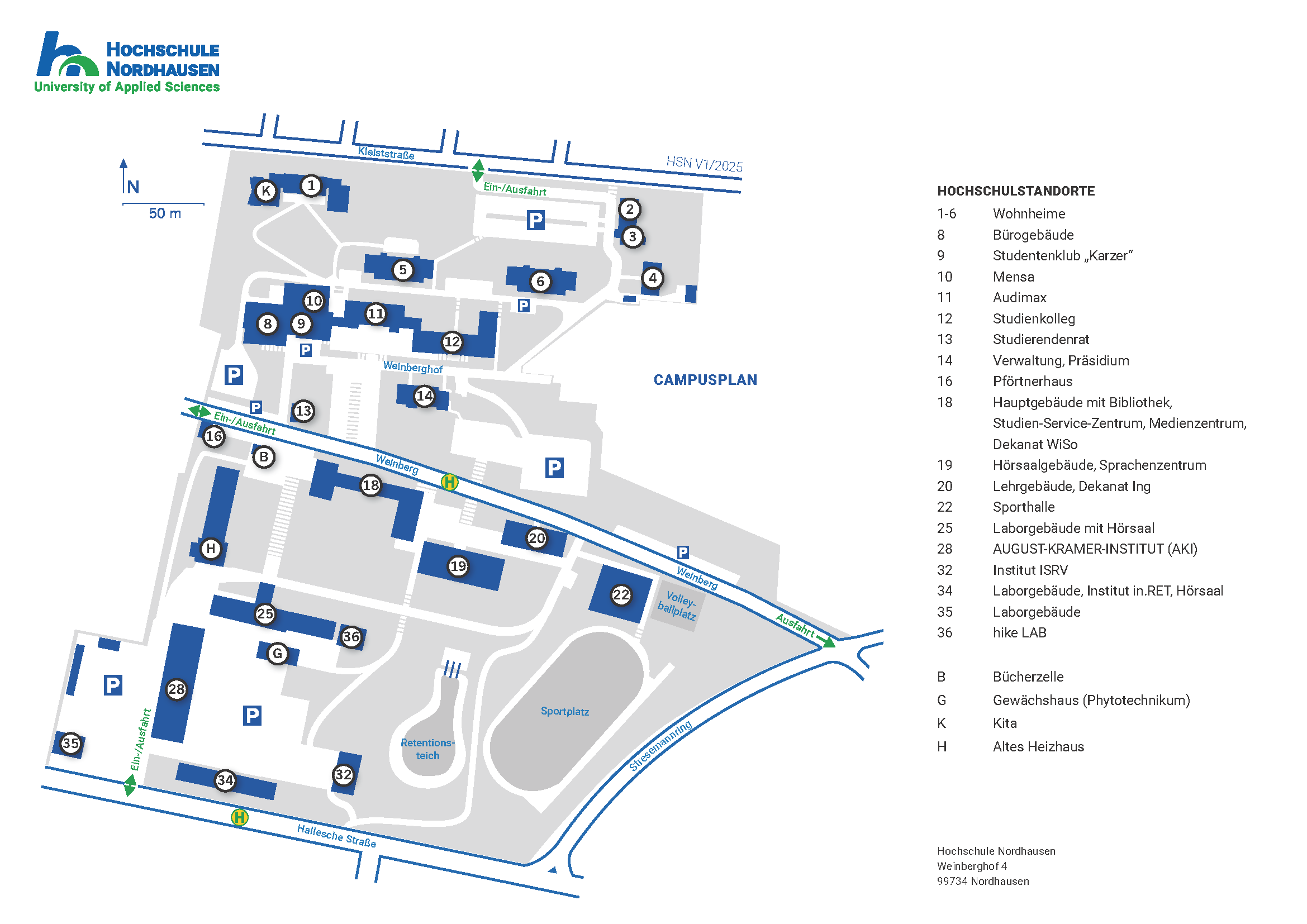


Study Service Centre
+49 3631 420-222
House 18, Level 1, Room 18.0105