



11 February 2026
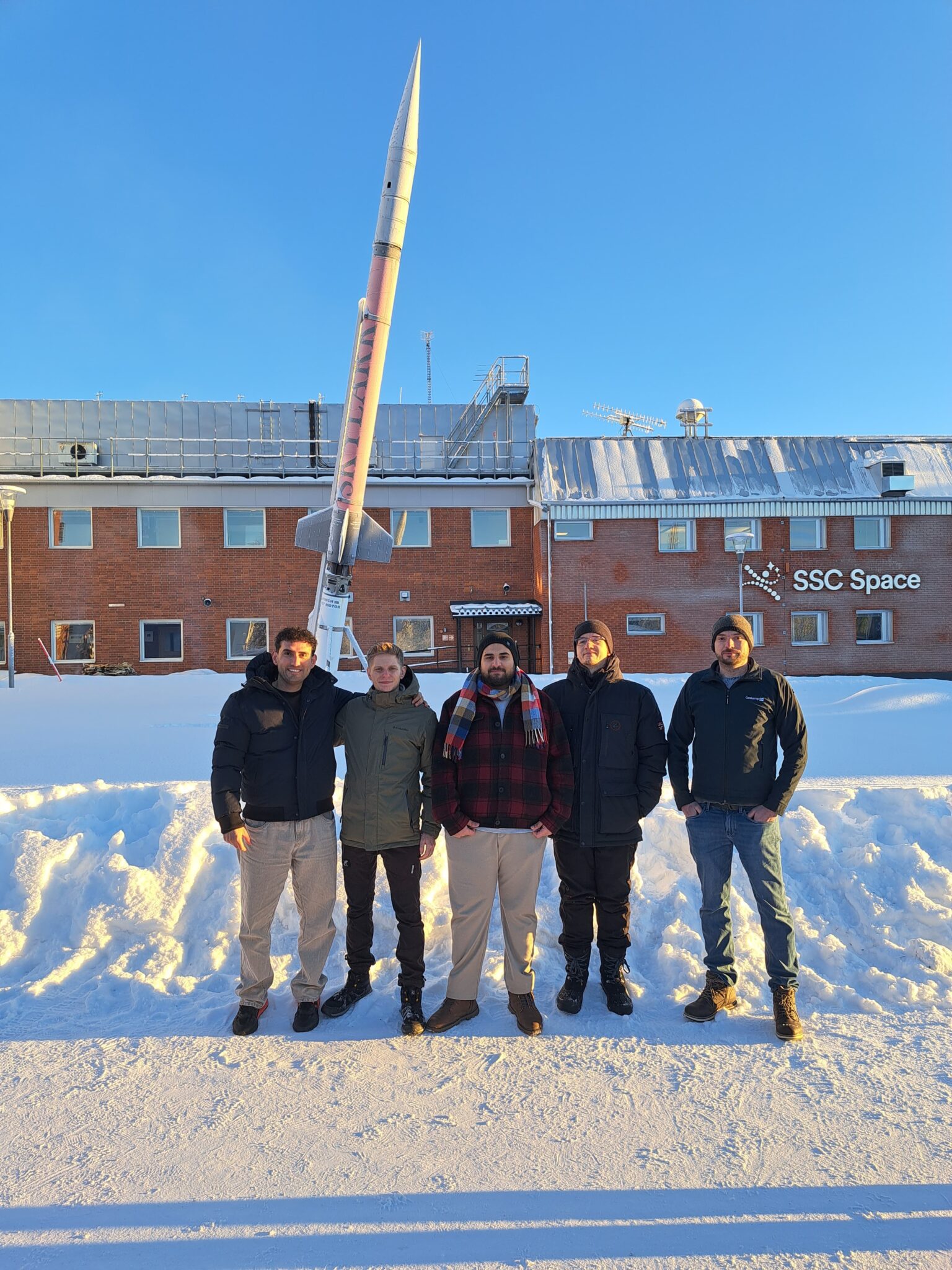
Great joy and justified pride at Nordhausen University of Applied Sciences: the BEXUS-ALBEDO student team has successfully presented itself in the selection process and has been allowed to conduct its experiment as part of a stratospheric balloon flight.
The student projects of the REXUS/BEXUS programme are funded and supported by the German Aerospace Center (DLR), the Swedish National Space Agency (SNSA), the European Space Agency (ESA), the Swedish Space Corporation (SSC) and ZARM Bremen.
Now in its fourth BEXUS experiment, Nordhausen University of Applied Sciences is once again part of an exclusive group of national and international colleges and universities that are allowed to carry out their research projects under real conditions at great heights.
The balloon flight is planned for autumn 2026 at the Esrange Space Center near Kiruna in northern Sweden. The aim of the experiment is to measure ultraviolet and infrared radiation as well as other light components up to an altitude of around 28 kilometres.
The conditions during the flight are extreme: outside temperatures of up to minus 70 degrees Celsius and an air pressure of just a few millibars place high demands on the technology and the team.
The project is being carried out by students on the Automation and Electronics Development degree programme and is being supervised by Prof. Dr Matthias Viehmann and Prof. Dr Klaus-Peter Neitzke as senior scientists.
Prof Viehmann emphasises the special significance for training:
„There's no need for big words - these experiments are engineering science in action for the students. They have the technical experience and team experiences for life.“
Back in January, the team completed a week of training at the Esrange Space Centre, the first EU spaceport on the European mainland. Now the next phase begins: the technical design of the experiment. Another international meeting will take place in May at the ESA site ESTEC near Amsterdam.
Share:
Technical employee
+49 3631 420-151
Building 12 (ground floor)
Head of University Marketing
+49 3631 420-113
Building 12 (ground floor)
Inclusion officer, website administrator / technical management
+49 3631 420-114
Building 11, Room 11.0101
You are currently viewing a placeholder content from YouTube. To access the actual content, click the button below. Please note that doing so will share data with third-party providers.
More Information


Study Service Centre
+49 3631 420-222
House 18, Level 1, Room 18.0105