



26 July 2022
Six regional partners are jointly researching an alternative solution to sewage sludge incineration. The CarboMass product is a regional approach that aims to minimise CO2 emissions into the atmosphere, reduce fees and at the same time make potash dumps more attractive and conserve groundwater.
With the amendment of the Sewage Sludge Ordinance, the previously practised soil-related sewage sludge utilisation will only be possible to a very limited extent from 2029. The ordinance thus aims to reduce the input of pollutants into agriculture and return the valuable component phosphorus to the economic cycle using innovative processes. Wastewater associations throughout Germany are currently examining which paths they want to take in future with regard to sewage sludge utilisation. So far, there is still a lot of indecision, but the trend is towards incineration.
In the southern Harz region, the six partners in the network - Nordhausen University of Applied Sciences, Wasserverband Südharz, Abwasserzweckverband Bode Wipper, IMM Sollstedt GmbH, the rural municipality of Bleicherode and the district of Nordhausen - are focussing on the pyrolysis of sewage sludge as an alternative to sewage sludge incineration. The main advantage here is the carbon sequestration in the product. While the incineration of sewage sludge releases CO2 is emitted into the atmosphere, pyrolysis can make a real contribution to CO2-minimisation can be achieved. The end product is a soil substitute called "CarboMass", which is mixed with biogenic residues and eliminates the need for future phosphorus recovery.
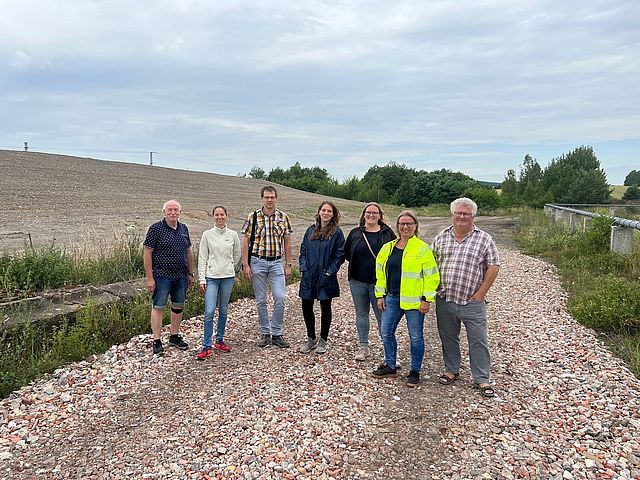
"CarboMass is to be used for the recultivation of potash dumps and, thanks to its positive properties, creates the conditions for good plant growth," explains project manager Prof Dr Uta Breuer. Whether this is the case is to be scientifically investigated under real conditions on a specially created test area at the Sollstedt potash dump. The collaborative team led by project coordinator Dr Anja Schreiber will be monitoring the production of the soil substitute and its use on the test site until mid-2024. A pilot pyrolysis plant with a throughput of 200 tonnes of dried sewage sludge per year is being built at the Bleicherode wastewater treatment plant specifically for this purpose. The soil substitute will then be piled up on the test area with a thickness of up to 1.5 metres by the alliance partner IMM Sollstedt GmbH.
In addition to the static properties of CarboMass, research is focussing in particular on the documentation of the developing flora and the qualitative and quantitative evaluation of any seepage water that may emerge after rain events. While saline water escapes from the body of the dump without a cover, the soil substitute and the developing vegetation should bind and utilise the precipitation.
Research over the next two years will now show to what extent the CarboMass product represents an alternative to sewage sludge incineration.
Share:
Technical employee
+49 3631 420-151
Building 12 (ground floor)
Head of University Marketing
+49 3631 420-113
Building 12 (ground floor)
Inclusion officer, website administrator / technical management
+49 3631 420-114
Building 11, Room 11.0101
You are currently viewing a placeholder content from YouTube. To access the actual content, click the button below. Please note that doing so will share data with third-party providers.
More Information


Study Service Centre
+49 3631 420-222
House 18, Level 1, Room 18.0105