



19 June 2026
Erfurt, 18 June 2026: Climate-neutral production is no longer a topic for the future; it can already be planned and implemented economically today. This is demonstrated by the findings of the Thuringian collaborative projects ZO.RRO II KMU and ZO.RRO 2 for Glass Industry at today’s closing conference at the Erfurt Chamber of Industry and Commerce (IHK), attended by around 100 participants from the worlds of business, research and politics.
Since 2019, partners from academia and industry have been working within the „ZO.RRO – Zero Carbon Cross Energy System“ energy project consortium, with funding from the federal and state governments, to develop solutions for a climate-neutral, secure and cost-effective energy supply. The focus is on small and medium-sized enterprises as well as energy-intensive sectors such as glass, metal, chemicals, ceramics, mechanical engineering and electronics.
„The results of the project provide important impetus for Thuringia and beyond,“ emphasises Thuringia’s Energy Minister, Tilo Kummer. „Improved energy efficiency and an energy supply that is as resilient to crises and affordable as possible represent an opportunity for the regional economy. Those who strategically restructure their energy supply can reduce costs, become less vulnerable to price fluctuations and thereby safeguard business locations and jobs.“
A key finding of the project is that there is no one-size-fits-all solution for the decarbonisation of industrial sites. Instead, companies need bespoke transformation pathways that take into account technical possibilities, investment costs, production processes and energy requirements. Digital tools were developed within the project specifically for this purpose – ranging from baseline analyses and simulations to concrete implementation planning.
Among other things, energy system simulations and AI-powered analysis tools were used. These help companies to make fact-based investment decisions, manage their facilities efficiently and better coordinate energy supply with production.
ZO.RRO also provides important insights that go beyond individual companies: Nordhausen University of Applied Sciences has developed a powerful open-source tool – the energy system modelling tool – which enables not only company sites but also entire regions, such as the Free State of Thuringia, to calculate scenarios for future energy supply. „This provides a fact-based foundation for business decisions, which can be validated by varying parameters across different scenarios,“ says Professor Viktor Wesselak of Nordhausen University of Applied Sciences.
In the ZO.RRO II SME Regional Project, funded by the Thuringian Ministry for the Environment, Energy, Nature Conservation and Forestry, the Thuringian Renewable Energy Network (ThEEN) e.V. also carried out a study of businesses across several industrial sectors in Thuringia. Across the board, the findings showed that the consistent expansion of renewable energies – particularly photovoltaics – the targeted use of storage systems, flexible production processes and smart energy management offer considerable economic potential. Another key cost-saving lever is the decarbonisation of heat supply. Heat pumps often prove to be a particularly efficient solution in this regard. A robust data foundation is crucial: measurement technology and continuous energy monitoring reveal potential savings and form the basis for well-informed investment decisions.
To provide practical support for businesses, ThEEN publishes the compact Results booklet: „Reducing energy costs. Securing the future.’.“. This guide provides SMEs with practical advice on how to take a structured approach to achieving climate-neutral production – from analysing energy consumption through to developing a long-term implementation strategy. The brochure is available to download free of charge: [LINK - https://zorro-thueringen.de/projekte/zo-rro-ii-kmu]
In the Federal project ZO.RRO 2 – Zero Carbon Cross-Energy System for the Glass Industry, funded by the Federal Ministry for Economic Affairs and Energy and led by a consortium headed by the Technical University of Ilmenau, solutions were developed specifically for the glass and metalworking industries. Through the investigation of fully electric glass melting processes, the development of energy-optimised production planning methods, energy-related digital twins and new AC/DC power supply concepts, it was demonstrated how energy-intensive production processes can be made more efficient, flexible and resilient. This work was complemented by AI-supported analysis tools and BSI-compliant measurement and control technologies for future industrial energy systems.
„ZO.RRO 2 has demonstrated that the electrification of energy-intensive industrial processes is technically feasible if energy supply, production planning and grid infrastructure are considered together,“ summarises Professor Dirk Westermann from the Thuringian Energy Research Institute at the Technical University of Ilmenau. „Through the use of digital twins, energy-optimised production planning and high-resolution measurement and control systems, further efficiency potential has been identified. At the same time, the results show that direct current technologies and resilient supply concepts can be key building blocks for the future energy supply of energy-intensive industries such as the glass industry.“
The conclusion after seven years of energy research within the ZO.RRO consortium is clear. A climate-neutral industry is achievable and can be economically viable. ZO.RRO provides concrete tools, practical examples and a blueprint for the transformation of the industrial energy supply, extending far beyond Thuringia.
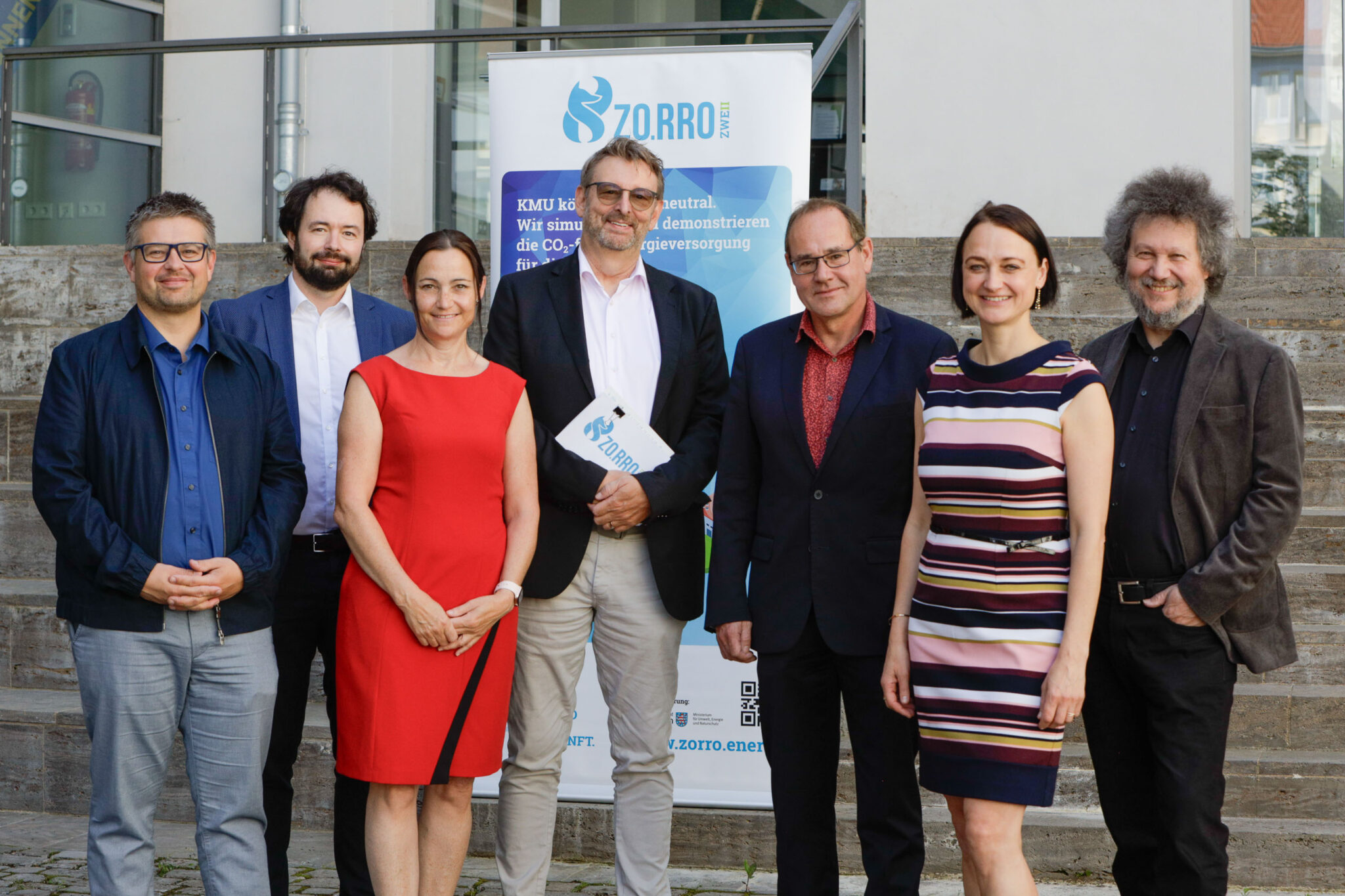
Photo (from left to right): Fabian Hoppe (HM Heizkörper GmbH Heating Technology/ThEEN), Dr.-Ing. Steffen Schlegel (Ilmenau University of Technology), Kristin Weiß (Stadtwerke Jena Netze GmbH/ThEEN), Univ.-Prof. Dr.-Ing. Dirk Westermann (Ilmenau University of Technology), Tilo Kummer (TMUENF), Dr Jana Liebe (ThEEN), Prof. Dr.-Ing. Viktor Wesselak (Nordhausen University of Applied Sciences)
Further information on the ZO.RRO projects can be found at www.zorro.energy
Press contact
Thuringian Ministry for the Environment, Energy and Nature Conservation, Tom Wetzling,
ThEEN e.V., Maria Siegl, e-mail: Tel.: 0361 663 82 286
About ZO.RRO II SMEs - Zero Carbon Cross Energy System - Case Study Thuringia
ZO.RRO II is a Thuringian energy research project investigating the transformation of our energy system. Nordhausen University of Applied Sciences and the Thuringian Renewable Energy Network (ThEEN) e.V. aim to demonstrate the decarbonisation of energy supply in Thuringian industrial enterprises. A key tool in this endeavour is energy system modelling based on open-source software. This has been used to calculate transformation pathways for the whole of Thuringia within a model, which provides an important scientific basis for the energy policy debate in the state. Using a further development of the energy system modelling – the Z.ENO tool – transformation pathways are also being calculated for small and medium-sized manufacturing enterprises (SMEs) in Thuringia, taking various sectors into account. ZO.RRO II is funded by the Thuringian Ministry for the Environment, Energy, Nature Conservation and Forestry from 1 January 2022 to 1 July 2026.
About ZO.RRO 2 – Zero Carbon Cross Energy for the Glass Industry
Using the Thuringian glass industry as a case study, ZO.RRO 2 investigated the transformation of energy-intensive industrial processes towards a climate-neutral yet highly reliable energy supply. The project developed and tested in practice solutions for the electrification of glass melting, energy-optimised production planning, energy digital twins, AC/DC supply concepts and intelligent measurement and control systems. The results show that the decarbonisation of energy-intensive industries requires an integrated approach to production, energy supply and grid infrastructure. The project is funded by the Federal Ministry for Economic Affairs and Energy (funding reference 03EI4073A-F).
Share:
Technical employee
+49 3631 420-151
Building 12 (ground floor)
Head of University Marketing
+49 3631 420-113
Building 12 (ground floor)
Inclusion officer, website administrator / technical management
+49 3631 420-114
Building 11, Room 11.0105
You are currently viewing a placeholder content from Instagram. To access the actual content, click the button below. Please note that doing so will share data with third-party providers.
More InformationYou are currently viewing a placeholder content from YouTube. To access the actual content, click the button below. Please note that doing so will share data with third-party providers.
More Information


Study Service Centre
+49 3631 420-222
House 18, Level 1, Room 18.0105