

- General Examination Regulations for the Bachelor's and Master's degree programmes in Health and Social Work at Nordhausen University of Applied Sciences


SGW
...social and health sciences?
... a social science?
Any scientific activity that deals with the phenomena and structures of human societies or the behaviour and interactions of people in societies.
...and health science?
Any scientific activity that researches the topic of health. This includes, among other things, the scientific study of the prevention of disease and the maintenance and restoration of health - both with regard to individuals and to communities, populations and environmental conditions.
...and why the combination?
Health should not only be understood as the absence of illness or infirmity in an individual, but as a comprehensive condition that also encompasses the life and integration of an individual in a society. This includes a wide variety of aspects, such as prosperity, income, work, housing, nutrition, social participation, political framework conditions, social security systems or healthcare systems and much more.
Our degree programme prepares you to work as a versatile expert at the interface between society and health. You will acquire sound scientific methodological skills and combine these with practical content from two sought-after areas: healthcare and the social sciences. This will open up numerous career opportunities for you, for example in the planning and management of social and health facilities, health promotion and prevention or the development of health policies.
Jobs in international development cooperation, social policy, counselling or scientific research are also conceivable. If you are interested in social challenges and their influence on health and would like to work in a scientifically sound manner, this degree programme offers you a broad and future-proof perspective.
| Study programme | Info |
|---|---|
| Short description: | SGW |
| Academic degree: | Master of Arts (M.A.) |
| Standard period of study / scope of services: | 3 semesters / 90 ECTS credits i |
| Teaching language: | German |
| Form of study: |
|
| Study start: | Winter semester and summer semester Enrolment is subject to approval by the Thuringian Ministry of Education, Science and Culture (TMBWK). |
| Pre-internship: | not required |
| Application period Start of the winter semester: | 1 April - 30 September (from winter semester 2026) |
| Application period Start of the summer semester: | 15 November - 31 March (from SoSe 2027) |
| Admission restriction: | Yes |
| Admission requirements: | Bachelor's degree in social work, health, social or educational sciences "good" |
| Tuition fees: | none |
Ready to help shape the future of a healthy society? Ready to lay the scientific foundations for this future? On our Master's programme, you will learn how to develop and successfully implement "research" and thus innovative solutions for complex challenges.
The Master's degree programme in Social and Health Sciences provides you with sound scientific methodological knowledge based on current topics in the fields of social and health sciences. You will acquire the ability to independently develop innovative solutions to complex problems, formulate research strategies and evaluate, implement and communicate projects in professional practice as well as in research and science. In this way, you will be optimally prepared to act successfully in a variety of professional contexts, to make scientifically sound decisions and perhaps even to work independently in a scientific capacity, e.g. as part of a doctorate.
In the 1st semester: A total of at least 5 modules must be taken: a module on research methods, a module on the implementation of research projects and a supplementary module (elective subject). In addition, a module on future trends and a more social science module on innovation, transformation and sustainability.
In the 2nd semester: At least 5 modules must again be taken: A module on research methods, a module on science communication and a supplementary module (elective subject). Furthermore, a module on solutions for future problems and a more health science module on intersectionality, demographic change and health.
In the final semester: Take another supplementary module (elective subject) if you have not already integrated this in previous semesters. Otherwise, you will only be involved in research for your Master's thesis (including the Master's colloquium).
Persons with a first professionally qualifying university degree (B.A., B.Sc.) in a social or educational science (e.g. social work, social pedagogy, curative education, sociology, etc.) or a health science (e.g. human medicine, psychology, nursing science, physiotherapy, etc.) who are interested in a more research-oriented Master's programme, e.g. in order to work in research or do a doctorate later on.
We train you to become a "generalist scientist" at the interface between society and health. The degree programme teaches very general skills in scientific methods and combines this with two highly sought-after areas: healthcare and social sciences. This opens up a wide range of career prospects later on. Here are some possible fields of work and sectors in which you could find employment:
Master of Arts (M.A.), recognised postgraduate degree from a state university, opens up access to the higher civil service and entitles the holder to a doctorate.
The degree programme was assessed by ACQUIN and is accredited by the Accreditation Council without conditions until 30 September 2033: „The degree programme is rated as very good by the committee. Student-centred teaching and learning is very well facilitated. Students are very well equipped to pursue a qualified career.“
Regulations applicable to the degree programme (published in the Official announcements of the HSN) and other guidelines:
Three reasons why you should study this degree programme at HSN:
via video conference on the following dates:
Simply click on "Video conference", dial in and ask your questions!
It's easy to secure your place on your desired degree programme online!
Our Campus Management System HISinOne makes it possible: Simply upload all your application documents in PDF format to the corresponding fields in the online portal.
And if you still need to submit something, that is No problem! You can easily send missing documents by e-mail to our Study Service Centre:
Simply contact us at .
We know that student budgets are often tight. To help you finance your studies, we provide you with the following information at BAföG helpful tips on how to apply and ensure that your application is complete. You will also find important contacts there.
We want to support and encourage particularly talented and motivated students. Under Scholarships you will find information on various scholarship programmes. There are also other funding options, such as the "StudiumThüringenPlus" start-up grant, parental funding, child benefit and the opportunity to earn your own money through a student job.
Students in continuing education programmes can find all information on the Funding opportunities.
What is the difference between studying at a University of Applied Sciences (UAS) and at a „Universität“ (university)? At our University of Applied Sciences, you will receive much more support throughout your learning process than at a traditional university. We provide self-assessment questions to help you check your understanding, offer practical exercises to deepen your knowledge, and encourage a high level of interaction in lectures and seminars. This is very different from courses with more than 300 students.
You are currently viewing a placeholder content from Instagram. To access the actual content, click the button below. Please note that doing so will share data with third-party providers.
More InformationYou are currently viewing a placeholder content from YouTube. To access the actual content, click the button below. Please note that doing so will share data with third-party providers.
More Information


Study Service Centre
+49 3631 420-222
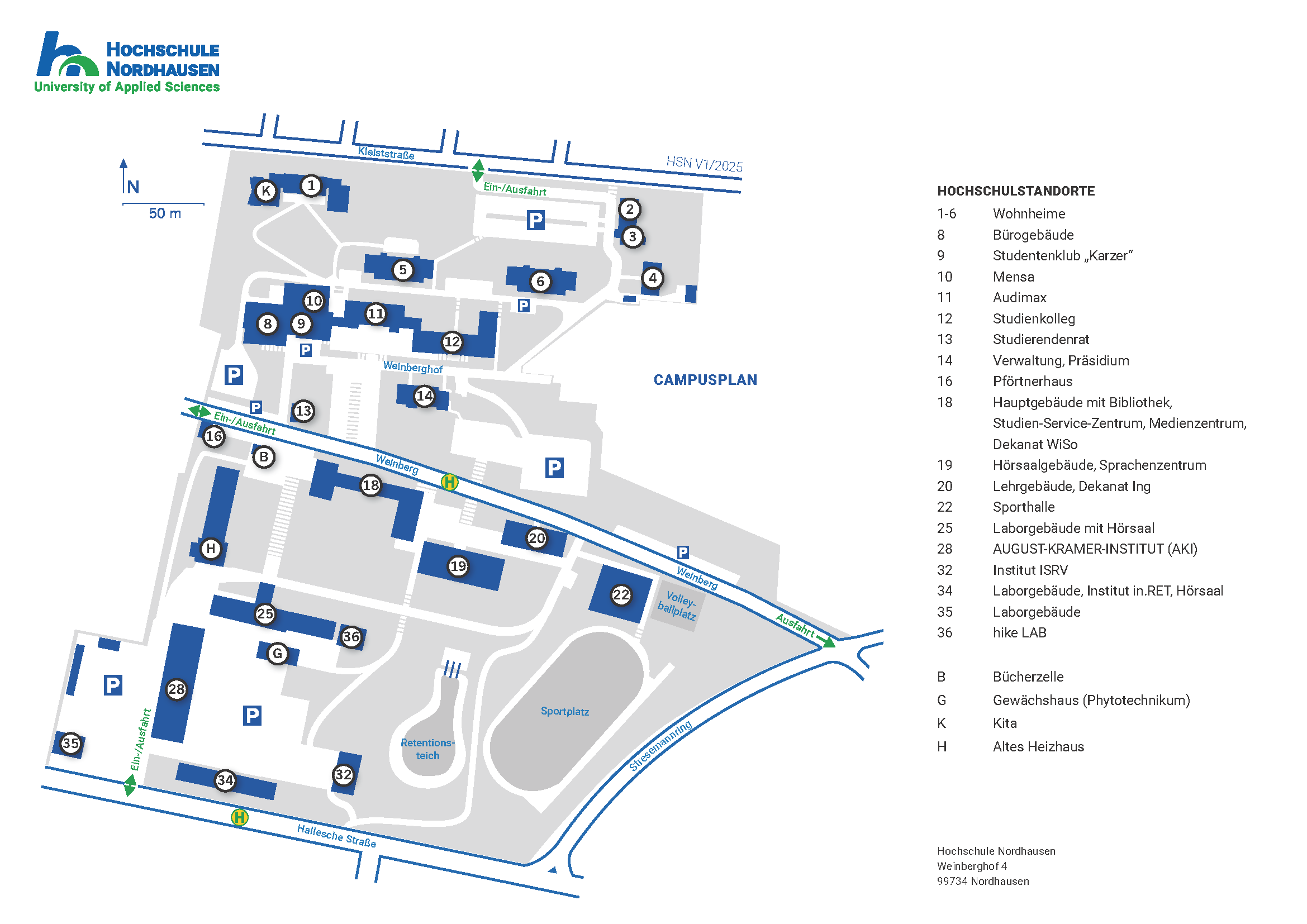
House 18, Level 1, Room 18.0105