


This further training course creates a scientifically sound and at the same time application-oriented in-depth training programme for professionals in psychosocial institutions who work with people who have experienced trauma and often need support due to trauma-related disorders.
This further training:
- sharpens the professional view of the people for whom we provide support in the facilities,
- promotes diagnostic-understanding trauma-sensitive approaches,
- teaches methods for emotional, physical and social stabilisation and support,
- expands self-reflection and
- promotes a sensitive view of one's own self-care.
In the certificate course "Trauma Pedagogy / Trauma Counselling", attendance times in the group alternate with a theory-practice transfer and peer group meetings. The course takes place over a period of one year and is based on six modules that build on each other thematically.
These take place as all-day block events from Thursdays to Saturdays (9.00 to 18.30) in Erfurt.
At a glance
| Certificate course | Info |
|---|---|
| Conclusion: | Certificate |
| Duration: | one year |
| Teaching language: | German |
| Format: | |
| Course start: | July 2026 |
| Prerequisites: | Professional activity in a psychosocial field of work |
| Registration period: | from now until 15.07.2026 |
| Admission restriction: | limited number of participants |
| General admission requirements: |
|
| Course fees: | 3,375.00 for the complete certificate course including supervision and DeGPT/FVTP certificate fee. There are also accommodation and catering costs depending on the needs of the participants. |
WTP dates course 2026-2027
Module name | Contents | Dates |
|---|---|---|
Module 01: Basics of trauma pedagogy | Psychotraumatology - diagnostic challenges - central concepts of trauma pedagogy - resource orientation and self-care | 13.-15.08.2026 |
Module 02: Reflection and self-awareness | Reflection on one's own professional role in relation to biography and present - Shaping relationships in trauma-centred areas of work - Self-awareness | 15.-17.10.2026 |
Module 03: Educational interventions for traumatisation | Prerequisites and possibilities for stabilisation - trauma-specific crisis intervention - basic knowledge of physical, social and psychological stabilisation - protection concepts against re-traumatisation | 17.-19.12.2026 |
Module 04: In-depth trauma counselling | General counselling approaches - trauma-centred, counselling planning and processes - differentiation between trauma education and trauma counselling | 11.-13.02.2027 |
Module 05: Specialisation in trauma pedagogy | Trauma pedagogical concepts and fields of action - trauma pedagogy in the context of different target groups and settings - group-centred trauma pedagogy - culturally sensitive trauma pedagogy | 08.-10.04.2027 |
Module 06: Final module | Project presentation and examination interview | 01.-03.07.2027 |
This training is suitable for professionals who work in psychosocial fields with children, young people and adults who have experienced trauma and need support (e.g. inpatient child and youth welfare facilities, care facilities, day centres, counselling centres, curative day groups, addiction counselling centres, school social work, assisted living, etc.).
With this further training you will receive a recognised double degree in trauma education / trauma counselling from the German Society for Psychotraumatology (DeGPT) and the Professional Association for Trauma Education (FVTP) if the requirements of both professional associations (further information at: www.degpt.de/weiterbildung-curricula) are fulfilled.
If certification requirements of the DeGPT/FVTP are not fulfilled, participation in the training is still possible. Participation will then be confirmed with a certificate from Nordhausen University of Applied Sciences.
Why should you take part in this continuing education programme at Nordhausen University of Applied Sciences in Erfurt?
- Working with people who have experienced complex traumatisation and are therefore challenging to interact with becomes easier.
- It's fun to work on content together in a group and then put it into practice at work the very next day.
- Satisfaction with the work increases.
- Erfurt is a great place for further education.
This training supports professionals who work with children, adolescents and adults who are traumatised and therefore have difficulties interacting in the following fields of work:
- Psychosocial facilities in outpatient, day-care and inpatient settings for children, adolescents and adults
- Counselling centres
- Crisis intervention facilities
- Family support services
- Individual assistance
Admission requirements for obtaining the certificate of the German Society for Psychotraumatology / Trauma Pedagogy Association
- Completed vocational training/technical schools in social administrative, educational or nursing professions (e.g. educators, nurses, midwives, occupational therapists, etc.) or
- University/university of applied sciences graduates with psychological, pedagogical and related degrees, e.g. qualified psychologists and doctors, qualified teachers, qualified social workers/educators, qualified special needs teachers, teachers, qualified theologians, qualified sociologists or analogous degrees (B.A., M.A.)
- at least three years of professional experience in a relevant field of practice for the listed occupational groups (internships and years of recognition also count)
- Full participation in all modules including supervision and certification module/ final module
- one project presentation and two anonymised case presentations (both oral and written). The written documentation of the case presentations and projects must be carried out according to a scheme provided by the institute. The candidate's case presentation and project must be supported by original documents (e.g. video or tape recordings, drawings, diary entries or similar by the client) and
- no more than 10 units of absences (absences in excess of this must be made up at the participant's expense).
Further information: www.degpt.de/weiterbildung-curricula
If certification requirements of the DeGPT/FVTP are not fulfilled, participation in the training is still possible. Participation will then be confirmed with a certificate from Nordhausen University of Applied Sciences.
- You download the Application form and send the completed form together with a
- A short CV in tabular form with your professional biography by e-mail to: .
- A short preliminary meeting is then arranged by telephone or online.
- You will receive confirmation of a permanent place on the continuing education programme once Nordhausen University of Applied Sciences has received your signed continuing education agreement.
The training is divided into six modules from Thursday to Saturday and takes place over a period of one year. Peer group meetings in an online setting are planned between the attendance phases.
The training is organised in cooperation with the EducationSt Ursula HouseErfurt, Germany.
Address of the seminar centre:

Bildungshaus St. Ursula, Trommsdorffstraße 29, 99084 Erfurt.
The educational centre is wheelchair accessible.
Approach
- by car to the Bildungshaus St. Ursula, Erfurt:
Either park in one of the large park-ride car parks on the outskirts of Erfurt and take the tram to the Anger stop (two minutes' walk from there) or park in the Anger1 multi-storey car park (two minutes' walk from there).
- by Deutsche Bahn to the Bildungshaus St. Ursula, Erfurt:
Ten minutes' walk from Erfurt main station or take the tram from Erfurt main station to the Anger stop (one stop) and then a two-minute walk.

Get a basic overview of financing and funding options for further training here:
- Information on further education funding (DGWF brochure)
- Funding opportunities for adult education (Recommendations from students)
- Further information is available, for example, at test.de, study-accompanying-jobs.de, study.com, vlh.de
- One In-depth research to the programmes enables the Funding search of the German Education Server for further education courses. Here you can find offers for Promotion of further training and legal regulations on further training.
- You will also find information about the Funding opportunities nationwide (D)and the Country-specific funding opportunities of the federal states*, such as the Educational Leave Act (Bildungsurlaubs-/Bildungsfreistellungsgesetz).
Foundation for the promotion of talented young people in vocational training
The Federal Ministry of Education and Research offers a direct funding option via the Foundation for the promotion of talented young people in vocational training. All related information can be found at: www.sbb-stipendien.de
Advancement scholarship - the study grant for experienced professionals
Current is the Online application for the Advancement scholarship - the study grant for experienced professionals possible again.
Prospective and current students can until Monday, 9 June 2025 apply for an advancement scholarship. The Scholarship programme of the Federal Ministry of Education and Research supports skilled workers with vocational training and several years of practical experience in their first academic degree programme.
Detailed information on the advancement scholarship
Financial and non-material support
For a Full-time study programme scholarship holders receive 992 euros per month plus 80 euros book allowance (i.e. a total of 1,072 euros) and 3,045 euros per calendar year for part-time study. The benefits are a lump sum and independent of income.
In addition, there is an extensive non-material supportThe scholarship holders can take part in numerous seminars on various topics. In addition, there are regional groups on site and a digital network through which they can network and exchange ideas with each other.applications are possible before the start of the programme and until the end of the second semester. There is no age limit for applications.
Information material and application counselling
If you have any questions about your application, our application counselling team will be happy to assist you. Our colleagues can be contacted by e-mail () or by telephone on 0228 / 62931 -43 or -51.
In addition, the Federal Ministry of Labour and Social Affairs, in cooperation with the employment agencies, offers a digital training guides to.
In some cases, employers contribute to the costs of a continuing education Master's degree programme / certificate programme / continuing education course. These in turn have the opportunity to Company-specific subsidies to obtain. When talking to your employer, please feel free to refer to the Employer service of the employment agency.
Costs for further training can, for example, be recognised as income-related expenses, tax deductible be made. You can obtain advice on this from the tax office.
We would be delighted if this compilation helps you to find a suitable funding opportunity for your further academic education at Nordhausen University of Applied Sciences.
Your team at the Institute for Academic Continuing Education
That's what we wish you!
You are welcome to contact us with any further questions.
Web Links:
Contact

Contact via e-mail is possible at any time and will be answered as quickly as possible:
Course management
 Photo: Tina Bergknapp (Nordhausen University of Applied Sciences)
Professor
+49 3631 420-554
Building 18, Room 18.0404


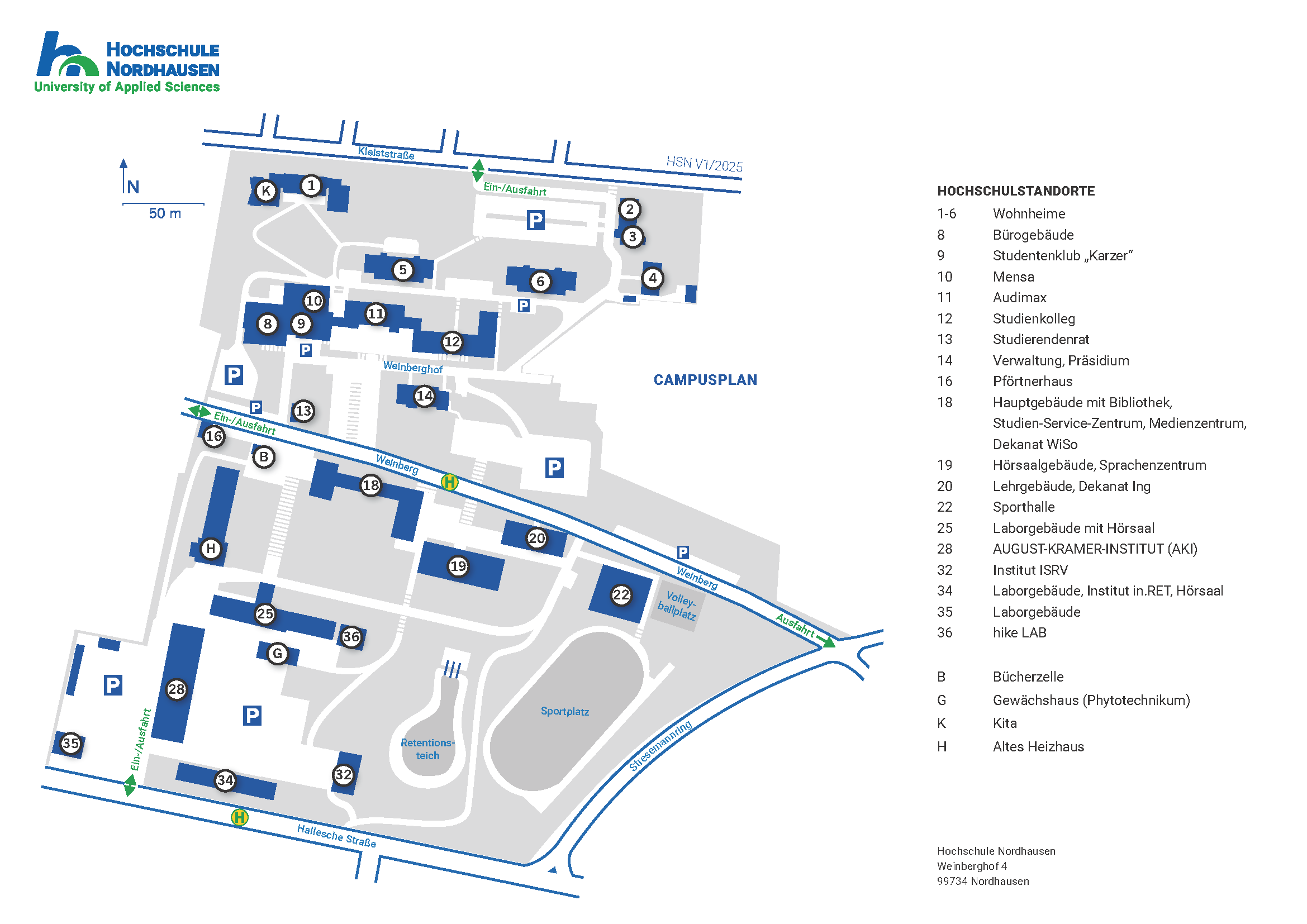
Study Service Centre
+49 3631 420-222
House 18, Level 1, Room 18.0105