



Overview
- Project title: Application-specific data encryption for KRITIS applications using multi-user QKD
- Acronym: AKRIT
- Support programme: FTI-Thuringia TECHNOLOGY
- Object of funding: Thuringia Network (VFE)
- Project number: 2024 VFE 0104
- Application number (original): 1003770
- Project duration: 24 months
- Coordinator: Quantum Optics Jena GmbH
Project description
Digitalisation is permeating all areas of life, but with increasing networking, the threat of cybercrime is also growing. Conventional encryption methods such as Diffie-Hellman key exchange are no longer considered future-proof in view of new technological possibilities (e.g. quantum computers). The consequences of successful attacks are particularly serious in the area of critical infrastructures (KRITIS), such as energy supply or data centres.
This is where the AKRIT joint project comes in: The aim is to develop and test a long-range QKD system based on entangled photons that is specifically tailored to the needs of KRITIS applications. In contrast to mathematical approaches to post-quantum cryptography (PQC), which remain potentially vulnerable, QKD utilises the laws of quantum physics to guarantee a fundamentally secure key exchange.
The project addresses key challenges of current QKD systems, such as increasing the range to over 100 kilometres and developing multi-user capabilities. The technology is being tested in a real field test in cooperation with enviaTEL GmbH in the data centre environment in Leipzig. With the goal of „IT security - Made in Thuringia“, AKRIT is making a decisive contribution to the technological maturity and future commercialisation of quantum technologies.
Aims and research questions
Scientific and technical work objectives
- Development of a long-range QKD system: increasing the range to over 100 km while maintaining practical key rates.
- Development of a QKD-secured VPN system: Creation of a secure VPN solution based on embedded Linux systems that utilises QKD keys.
- Multi-user capability: Research into how multiple users can be integrated into a QKD network in a resource-saving manner.
- Generation of true random numbers (QRNG): Provision of physically generated random numbers for cryptographic applications.
- Validation in the field test: Testing of the overall system under real conditions in a critical infrastructure.
Central research questions
- Can the system be certified according to Common Criteria (EAL4+) in the future?
- How can QKD technology be transferred to KRITIS areas in compliance with ITU-T standards?
- Which hardware and software interfaces are required for integration?
- How can multiple users be implemented in a quantum network in a resource-efficient way?
- Will the performance of KRITIS applications (e.g. the control of energy networks) be maintained when using quantum encryption?
Project partners
AKRIT combines the expertise of leading industrial companies and applied research:
| Partner | Role in the project |
|---|---|
| Quantum Optics Jena GmbH | Coordinator; development of the long-range and multi-user QKD system, embedded OS, QRNG features. |
| Nordhausen University of Applied Sciences | Academic partner; research and development of QKD-secured VPN systems based on embedded Linux for multi-user scenarios. |
| Ilmotronics GmbH | Industrial partner; research and development of highly efficient single-photon detectors for telecommunication wavelengths. |
| enviaTEL GmbH | Associated partner; provision of the fibre optic infrastructure for the field test in the data centre environment in Leipzig. |
| Thüringer Energienetze GmbH & Co. KG | Associated partner; consumers and users from the KRITIS energy supply sector. |
Project structure and milestones
The project is divided into five phases with a total duration of 24 months:
- Phase 5: Technical testing in the KRITIS test field (12 months)
- Phase 1: Specification and conceptualisation (2 months)
- Phase 2: Interface design (2 months)
- Phase 3: Research & development hardware/software (11 months)
- Phase 4: Technical validation (7 months)
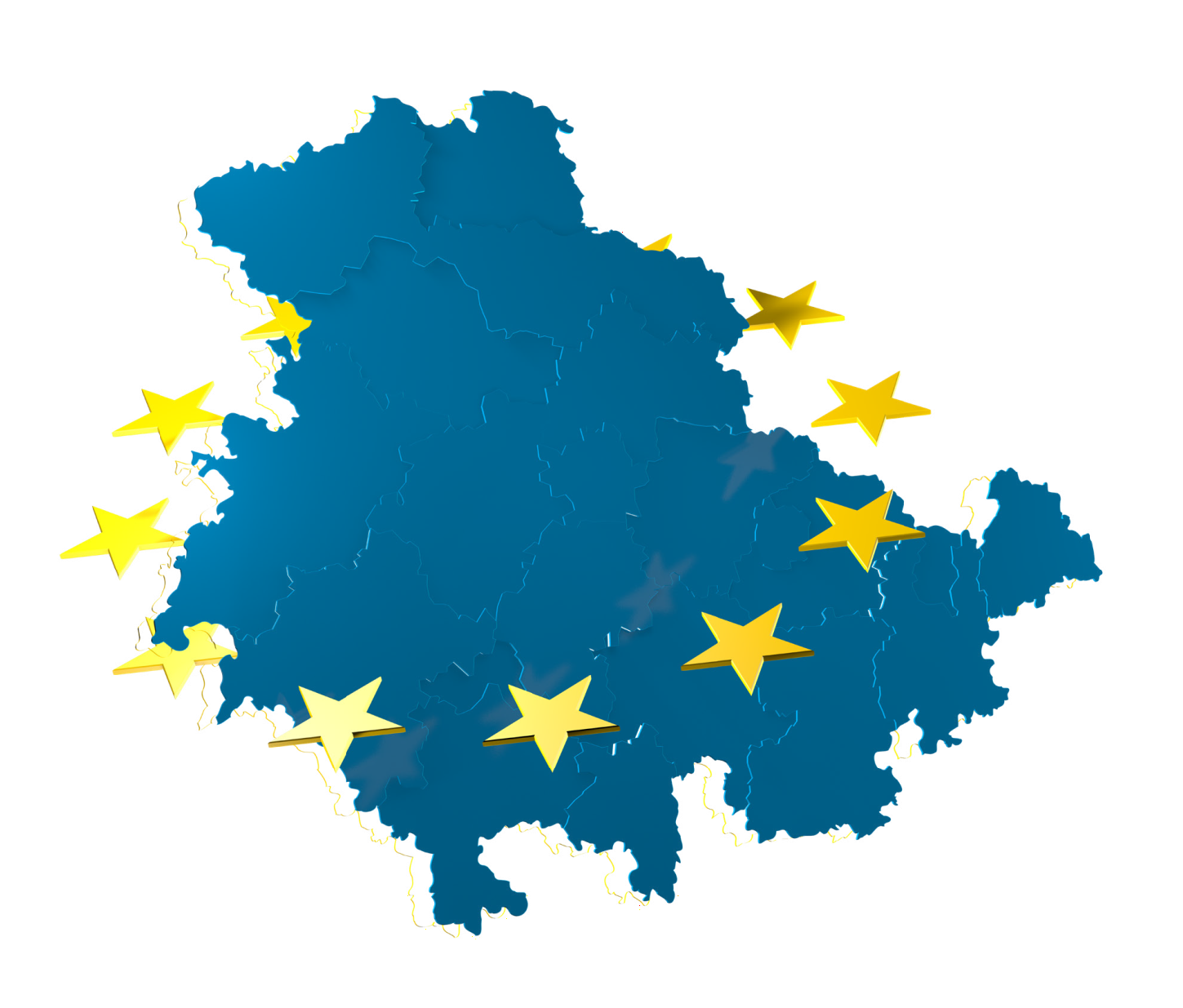
 Photo: InfiniteFlow/stock.adobe.com
Promotion
- Support programme: FTI-Thuringia TECHNOLOGY
- Object of funding: Thuringia Network (VFE)
EFRE - FTI-Thuringia Technology
The project, which was funded by the Free State of Thuringia, was co-financed by the European Union as part of the European Regional Development Fund (ERDF).“


Study Service Centre
+49 3631 420-222
House 18, Level 1, Room 18.0105