12 December 2025
As part of the ZO.RRO II research project* funded by the Free State of Thuringia, a current study by the Institute for Regenerative Energy Technology (in.RET) at Nordhausen University of Applied Sciences is analysing how different expansion paths for wind power will affect the structure and overall costs of the energy supply in Thuringia up to 2045. The analysis is based on a detailed energy system model that maps the regional energy supply over the course of the hour and takes into account both technical potential and future energy requirements.
1) Prof. Dr Viktor Wesselak (Nordhausen University of Applied Sciences) presenting his paper on the influence of wind power on the overall costs of the energy system in Thuringia at the 32nd REGWA Symposium | © Nordhausen University of Applied Sciences
2) Illustration of energy system modelling with energy sources, conversion processes, storage and consumption sectors © Nordhausen University of Applied Sciences
The results show that the availability of wind power strongly influences the costs and composition of the energy system. The wind power potential was varied in the model calculations: from an expansion to 2.2 per cent of the land area, as currently envisaged in regional planning, to no wind turbines at all. While the first variant represents the cost optimum, the costs increase further with each reduction in the available wind power capacity. Ultimately, completely dispensing with wind turbines would make Thuringia's energy supply 45 per cent more expensive than in the optimum scenario.
If a restriction on the expansion of renewable energies based on regional requirements is introduced, the cost-optimal solution would require around 2 per cent of the state's surface area for wind power. If the wind power potential falls below 0.8 per cent of the state's surface area, Thuringia will no longer be self-sufficient in terms of energy - Thuringia will become an energy importing state.
A lack of wind power can only be compensated for to a limited extent by an increased expansion of photovoltaics: while photovoltaic systems produce energy in the summer months in particular, the opposite is true for wind power plants. A reduction in the available wind power potential leads to a winter electricity shortfall in Thuringia, which has to be compensated for by importing comparatively expensive electricity. The model calculations show that an optimum cost is achieved with a ratio of wind to photovoltaic output of 1:1.4. If this ratio is deviated from to the detriment of wind power, this leads to higher overall costs for the energy system.
„The results confirm that a discussion about technological openness absolutely requires cost transparency. Technologies can only be seriously compared with one another if a price tag is attached,“ says Prof Dr Viktor Wesselak, ZO.RRO II project manager at Nordhausen University of Applied Sciences.
The model calculations also take into account the interactions with other energy sectors. For example, if sufficient wind power is available, power-to-heat plants and local heat storage facilities can be used to supply district heating. Thuringia's biomass potential is already being utilised intensively today and is only available to a limited extent for expansion in the area of heat supply. The model shows an advantage for existing biogas plants if they are converted to the production of biomethane, as this helps to cover the fuel gas demand that will still exist in 2045.
The methodology, assumptions and results were first presented at the 32nd Energy Symposium in Stralsund at the beginning of November. The full paper „Influence of the wind power share in the energy mix on the total economic costs of the energy system - The example of Thuringia“ is available here: https://www.hs-nordhausen.de/wp-content/uploads/sites/8/2025/12/REGWA25_Paper_PV_Wind.pdf
The ZO.RRO II KMU project, jointly managed by Nordhausen University of Applied Sciences and the Thuringian Renewable Energy Network (ThEEN) e.V., is funded by the Free State of Thuringia through the Thuringian Ministry for the Environment, Energy, Nature Conservation and Forestry.
The aim is to calculate realistic future scenarios for a climate-neutral energy supply for the entire Free State of Thuringia and specifically for small and medium-sized enterprises in Thuringian industry (SMEs). These pilot projects will result in a valuable transfer of knowledge for the Thuringian economy and beyond by July 2026. At the heart of the work are digital tools, such as energy system modelling, which provide support on the path to climate neutrality. You can find more information about the ZO.RRO II project online at www.zorro-thueringen.de.
* Project funding by the Thuringian Ministry for the Environment, Energy and Nature Conservation




Study Service Centre
+49 3631 420-222
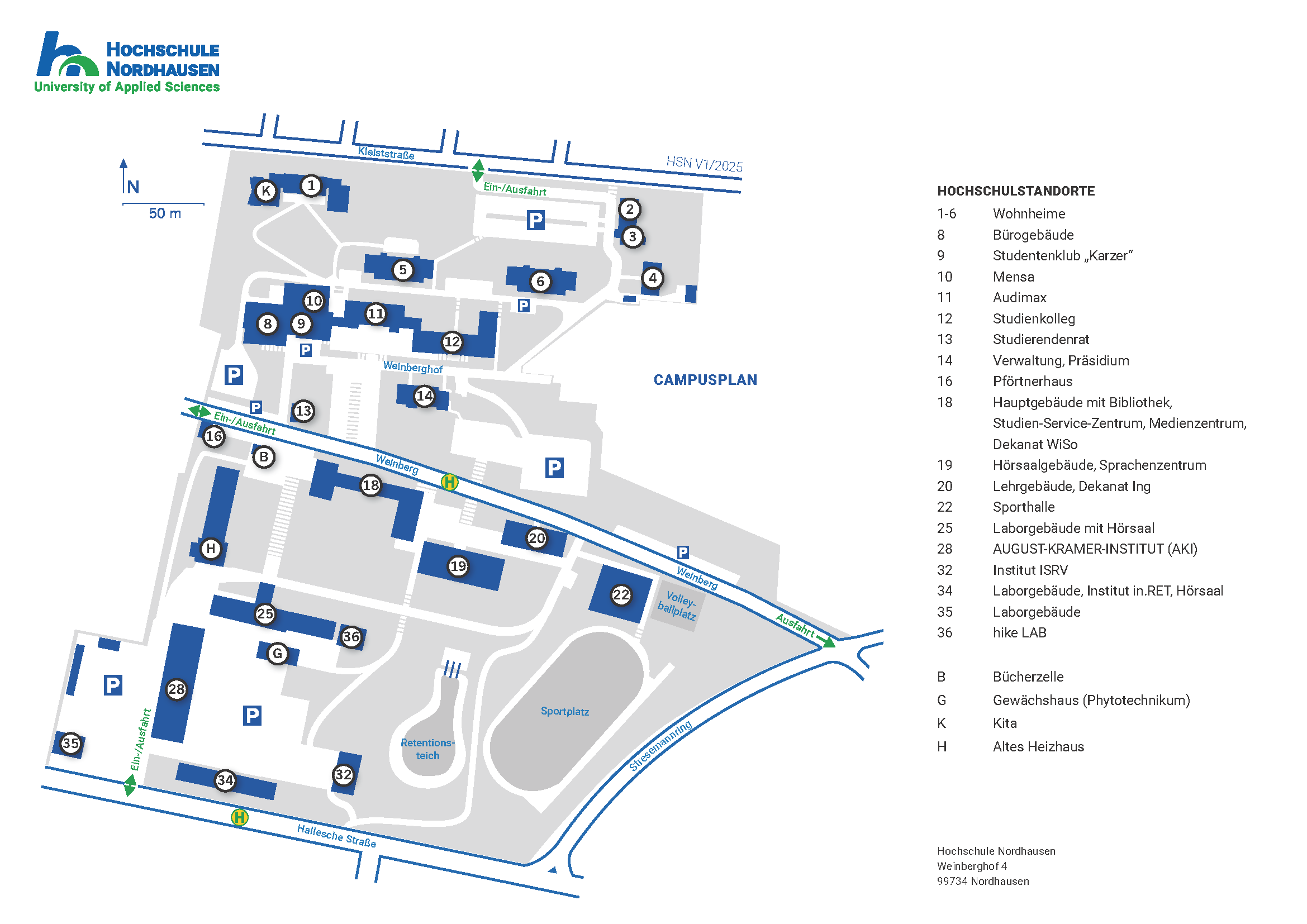
House 18, Level 1, Room 18.0105