


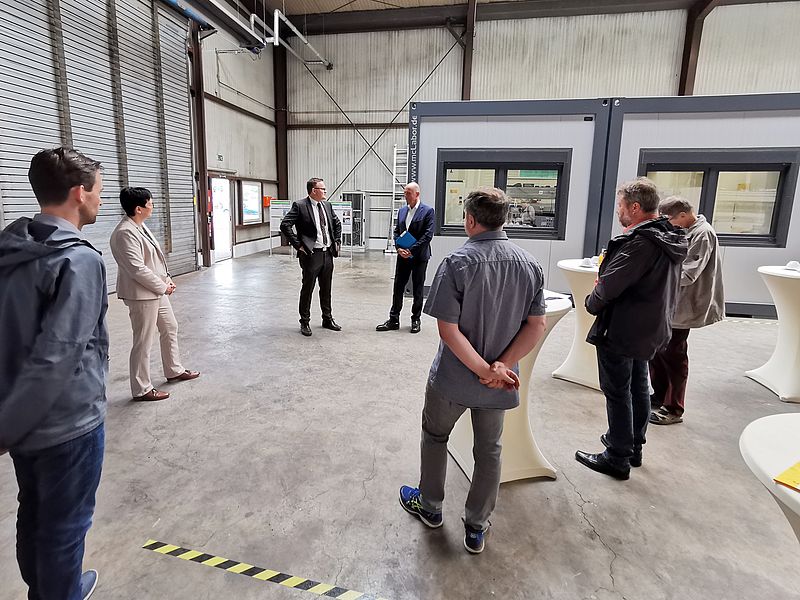

With the "ZerMoGips" research project, Nordhausen University of Applied Sciences intends to research and develop reusable gypsum building products over the next two years. Science Minister Wolfgang Tiefensee handed over the 750,000 euro funding decision to University President Prof Dr Jörg Wagner today. "The project makes a significant contribution to conserving natural gypsum resources and thus the environment. It is a boost for the transition to recyclable materials in the construction sector and will be a central topic in the Thuringian research network 'Sustainable Construction and Resource Management'," said Mr Tiefensee. ZerMoGips is one of four research projects in the network that are being funded by the state with 3 million euros as part of the Innovation Potential package of measures.
A good half of the gypsum required in Germany - around six million tonnes - is currently obtained as a by-product (so-called "FGD gypsum") from coal-fired power plants, while only around five million tonnes are extracted from quarries. With the planned phase-out of coal by 2038 and the elimination of FGD gypsum as a by-product of coal extraction, the development of marketable gypsum substitutes and gypsum recycling are high on the agenda. The ZerMoGips" project - Development of non-destructive deconstructable, reusable gypsum building products for the creation of variable, modular utilisation units" - aims to develop non-destructive deconstructable gypsum products that can be reused - from design, production and testing to application as modular components. The directly reusable gypsum products are a supplement to gypsum recycling, which is associated with CO2 emissions and is energy-intensive due to the necessary collection, preparation and transport processes. They therefore contribute to meeting the demand for gypsum while at the same time protecting the southern Harz gypsum karst region, for example, where half of the national gypsum resources are stored.
ZerMoGips is one of four co-operative research projects of the Network "Sustainable Building and Resource Management"which deal with the overall problem of "Alternatives to the mining of natural gypsum and closing the supply gap due to the elimination of FGD gypsum from coal-fired power generation" and are closely interlinked. Four Thuringian research institutions are involved in the network: the F.A.Finger Institute for Building Materials Science (FIB) of the Bauhaus University Weimar, the Materials Research and Testing Institute (MFPA) Weimarthat Institute for Applied Building Research (IAB) Weimar and the Thuringian Innovation Centre for Recyclable Materials (ThIWert) at Nordhausen University of Applied Sciences. With around 300 scientists in these institutions, Thuringia has a research density in this area that is unrivalled in Germany. Core topics include research into alternative building materials, the development of return concepts and recycling processes, saving gypsum, for example, through new hybrid building products and the functionalisation of materials and components as well as the nature and landscape-friendly design of post-mining landscapes. "As the most important gypsum mining region in Germany, Thuringia has practical expertise and has built up considerable research expertise in Nordhausen (recycling) and Weimar (substitute building materials) in recent years," said Tiefensee. As part of the programme launched in 2020 "Innovation potential" package of measures the state is providing 6 million euros to further strengthen the research alliance. Half of the funds will go towards the four co-operative research projects; a further three million euros are available for the required research space at Nordhausen University of Applied Sciences. The plan is to acquire space already rented for the "Thuringian Innovation Centre for Recyclable Materials" (ThIWert).
Tiefensee said that the state had already invested in research at an early stage in order to drive forward the transition to recyclable materials and play a pioneering role in gypsum recycling, for example. Since 2018, the "Thuringian Innovation Centre for Recyclable Materials" (ThIWert) at Nordhausen University of Applied Sciences, funded with 6.5 million euros, has been developing and testing technologies for a sustainable recycling and circular economy in cooperation with Bauhaus University and the Institute for Applied Building Research (IAB) in Weimar. In this context, various grants from the German Research Foundation (DFG) and the federal government - including the BMBF initiative "WIR! Change through innovation in the region" for the alliance "Gypsum recycling as an opportunity for the southern Harz region" - were acquired. The alliance Resource Management for Sustainable Building, coordinated by MFPA Weimar, is on a successful path as part of the second WIR funding round "renat-BAU". The project has so far been selected for the concept phase and is now applying for funding for the implementation phase. "These federal subsidies leverage the state investments many times over," says Tiefensee.


Study Service Centre
+49 3631 420-222
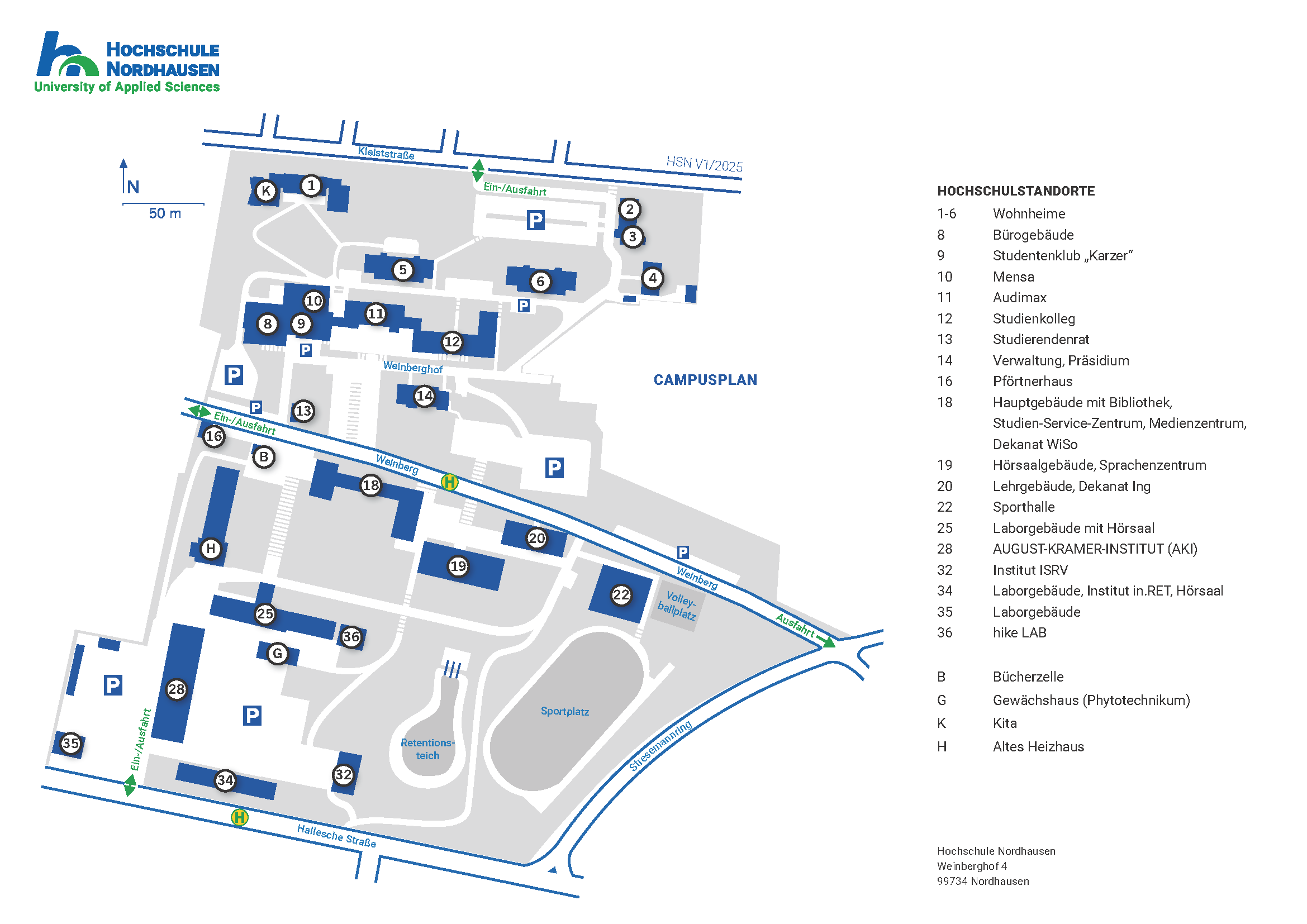
House 18, Level 1, Room 18.0105