


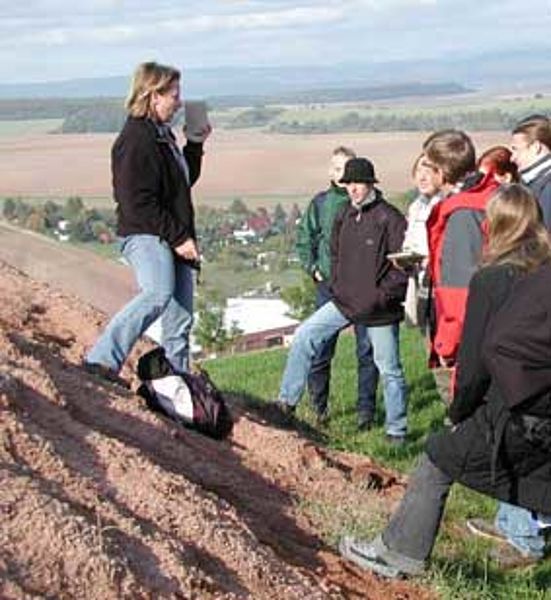
The young scientist was drawn to the southern Harz region by her work. After studying geography at Saarland University, she joined K-UTEC GmbH in 1996, working in the waste/contaminated sites department. It was here that her work drew her attention to the issue of waste dumps and since 1999 she has been intensively involved in field work and data analysis on waste dumps and their emissions. Thanks to funding from the Thuringian Ministry of Science, Research and the Arts as a junior researcher and her parallel work as a lecturer at Nordhausen University of Applied Sciences, she was able to make rapid progress with her work and complete it after almost four years.
Ms Parnieske-Pasterkamp's doctoral thesis is entitled "On the geoecology and geochemistry of potash industry tailings piles in northern Thuringia". In it, the scientist analyses the environmental impact and ageing of the salt dumps in the former potash district in the southern Harz. In particular, the spoil tips in Bischofferode and Menteroda, the former Volkeroda shaft, served as her research object in order to recognise the extent to which the spoil tips react to changing influences, such as infiltration of precipitation and covering with soil materials.
The waste rock piles are a major burden on the environment in the southern Harz region, as the study showed that around 350,000 tonnes of salt are discharged into the environment from the six large waste rock piles in the region every year, polluting water bodies and groundwater.
The covering of the stockpiles, some of which already reach a height of 100 metres, is intended to significantly reduce this input. Biological sealing is intended to reduce rainfall seepage and prevent the salts from dissolving so quickly in order to ensure the long-term usability of ground and surface waters in the region. This is the primary objective, as the salt solution discharged, which contains 80 % of common salt, is not dangerous in itself, but the quantity is the decisive problem.
The scientist was able to prove through her work that sealing the surface of the dumps, similar to the sealing of a landfill body with subsequent recultivation, can significantly reduce the salt discharge. While 20 % of the salt discharge is currently retained by the covering, she was able to show that after a complete recultivation planned for the medium term, the salt discharge can be reduced to half of the original values.
This is an important measure, because the spoil tips that will be piled up in a few decades will be with us for a long time to come and will pollute the environment. According to Mrs Parnieske-Pasterkamp's calculations, the waste tips will take around 1000 years to decompose, depending on their surface area without covering and recultivation. With recultivation, the period would be extended to more than 2000 years.
Press release 25/2004


Study Service Centre
+49 3631 420-222
House 18, Level 1, Room 18.0105