


| Project name: | Energetic utilisation of biogenic residues using the example of horse manure pellets |
| Running time: | |
| Funding code: | |
| Project organiser: | |
| Project management: | |
| Employee: | |
| Project partners/consortium: | |
| Funding amount: | |
| Third-party donors: |
As a renewable energy source, biomass plays a central role in the German heating market. Traditionally, the use of wood as an energy source has taken centre stage, although the economically available potential is limited. Accordingly, there is increasing interest in the utilisation of residual materials for energy purposes. In agriculture in particular, large quantities of different residues are produced which are currently not utilised, or only to a limited extent. However, some of these residues differ significantly from conventional wood fuels in terms of their chemical and physical properties and therefore their combustion and emission behaviour.
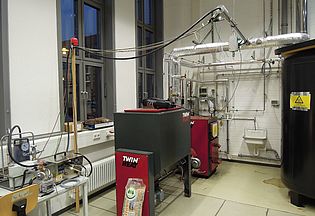
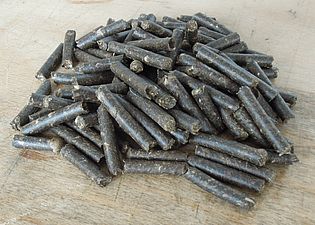
The question of the extent to which such residual materials can be used as an energy source is therefore of great importance. This question was investigated as part of a research project carried out by the Institute for Regenerative Energy Technology (in.RET) in cooperation with the company M.A.M. Energietechnik GmbH from Suhl.
In view of the growing need for horse farms to dispose of their manure, the project focussed on the use of horse manure. The material first had to be dried using an innovative low-temperature drying process developed by the project partner. The dried source material was first pelletised at in.RET in order to produce homogeneous and possibly standardisable fuels. The pellets were then burnt in a 30 kW biomass boiler and the resulting dust and pollutant emissions were measured. The chemical and physical properties of the pellets were compared with the specifications of the relevant EU standard, the resulting emissions were compared with the limit values of the 1st BImSchV and the ash was analysed. These tests and the results obtained will be discussed in more detail in the presentation.
As a result, it was shown that pelletising the raw materials produces a fuel that largely meets the requirements of the EU standard and that agricultural residues can be used in small plants. The CO and NOx emissions determined during the combustion tests showed that complete combustion of such residue pellets is feasible. Somewhat more problematic are the dust emissions and ash content, which increase significantly compared to the combustion of pure wood pellets. There are approaches for optimising these fuels, which are to be investigated in further research work.
You are currently viewing a placeholder content from Instagram. To access the actual content, click the button below. Please note that doing so will share data with third-party providers.
More InformationYou are currently viewing a placeholder content from YouTube. To access the actual content, click the button below. Please note that doing so will share data with third-party providers.
More Information


Study Service Centre
+49 3631 420-222
House 18, Level 1, Room 18.0105