


Demonstration of manufacturer-independent quantum key distribution (QKD) for critical infrastructures in the Sundhausen healthcare kiosk (Photos: Tina Bergknapp)
26 February 2026
Completion of the „Q-net-Q“ research project - Nordhausen University of Applied Sciences and partners demonstrate manufacturer-independent quantum key distribution (QKD) for critical infrastructures
Demonstration of manufacturer-independent quantum key distribution (QKD) for critical infrastructures in the Sundhausen healthcare kiosk (Photos: Tina Bergknapp)
Berlin/Sundhausen/Nordhausen/Jena/Frankfurt, 26 February 2026 - After more than three years, the Q-net-Q research consortium, led by Nordhausen University of Applied Sciences and involving the Fraunhofer HHI (Fraunhofer Institute for Telecommunications, Heinrich Hertz Institute) and the Fraunhofer Institute for Applied Optics and Precision Engineering (IOF), has demonstrated the successful implementation of a quantum infrastructure in real-life operation. Several aspects of a QKD-secured network were demonstrated as part of a final presentation.
The functionality of a 150 km long regional test track was demonstrated in the Sundhausen health kiosk, which was connected via a 680 km long-distance link from the Fraunhofer HHI in Berlin via Erfurt to Frankfurt am Main. The project validates the integration of quantum key distribution (QKD) into existing ICT networks to secure highly sensitive data transmissions. The Fraunhofer HHI was in charge of planning and operating the long-distance QKD link between Berlin and Frankfurt am Main.
The project, co-financed with 11.8 million euros by the Federal Ministry of Research, Technology and Space (BMFTR) and the European Union (ERDF), demonstrates the operational readiness of QKD systems outside of controlled laboratory conditions. „With the completion of Q-net-Q, we are demonstrating the successful transfer of physical high technology into the regional supply infrastructure. The Sundhausen site acts as a real-life laboratory for digital sovereignty in rural areas,“ says Prof Dr Jörg Wagner, President of Nordhausen University of Applied Sciences.
Four testbeds for the European security architecture
The research work focussed on four differentiated test environments (testbeds). In addition to Sundhausen's regional connection, the consortium evaluated the performance of key generation on a large-scale wide area connection: This stretches from the DE-CIX Internet node in Frankfurt am Main via Erfurt to the Fraunhofer HHI in Berlin and comprises over 680 km of quantum-secured fibre optic connection. A central QKD endpoint was set up at DE-CIX in Frankfurt for this purpose, where several of the latest HHI QKD systems were installed and integrated into the existing fibre optic infrastructure of the Internet node.
The common hub of these connections is the Fraunhofer Centre Erfurt under the direction of the Fraunhofer IOF. „The Erfurt site acted as a mission-critical central node for the control of classic communication and the hardware control of all four testbeds,“ describes the Fraunhofer IOF. Dr Natasa Pavlovic Tucakovic from the Fraunhofer IOF. The use of software-defined network control (SDN) also enabled multi-vendor validation - the technological coupling of hardware from different manufacturers within one system.
„With the 680-kilometre Trusted Node route, we have shown that our QKD technology can reliably and continuously exchange keys over long distances - even under real field conditions and with different detector technologies,“ explain Dr Andy Schreier and Dr Julius Schulz-Zander from Fraunhofer HHI.
„This route forms the backbone of the Q-net-Q network and shows that interoperable, long-range quantum communication can already be integrated into existing networks today.“
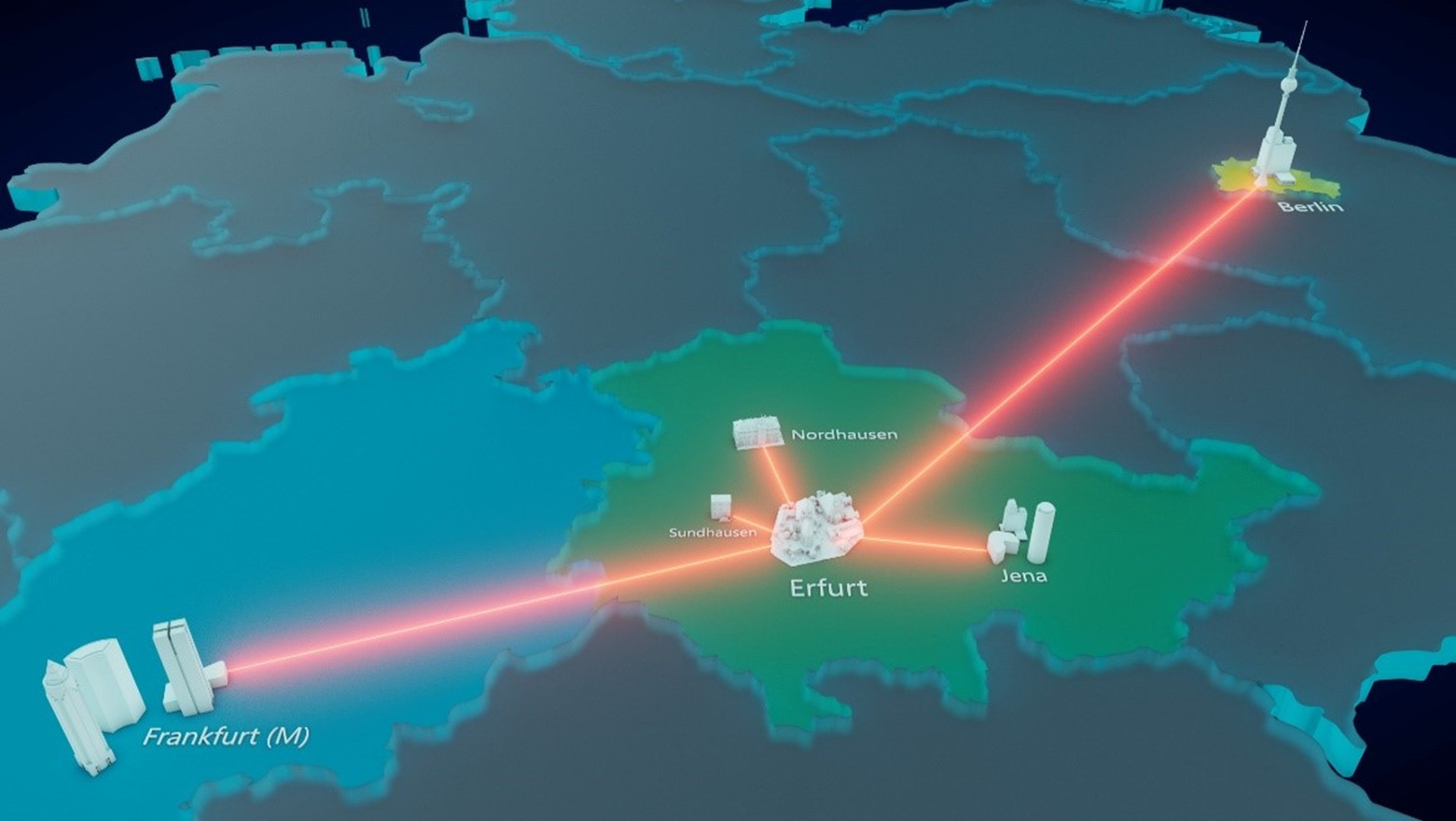
Schematic representation of the test tracks.
© Fraunhofer IOF
The health kiosk: where high technology meets social innovation
It is no coincidence that the Sundhausen health kiosk was chosen for the final presentation. Health kiosks form an important backbone of future regional healthcare by offering medical advice and telemedical services where GP capacities are scarce. The health kiosk served as an operational interface in the project to demonstrate that the highly complex quantum highway can guarantee the protection of patient data in everyday life.
Live demonstration: The telemedical practice check
The practical application was demonstrated using a realistic teleconsultation between Sundhausen and Jena. An eHealth system (MEYTEC) was used in the health kiosk to collect vital parameters such as pulse and oxygen saturation. This highly sensitive data was encrypted and transmitted in real time via a quantum access point. In Jena Dr Albrecht Günther, Senior Physician at Jena University Hospital, The patient was able to view the incoming values via a tablet solution, demonstrating the seamless integration of safety technology into the medical workflow.
Strong alliance of science and practice
The success of Q-net-Q is based on the close cooperation of a nationwide consortium. As consortium leader, Nordhausen University of Applied Sciences was responsible for strategic management and transfer to the region. The Fraunhofer Institutes HHI (Berlin) and IOF (Jena) contributed their expertise in quantum technology, optical systems and the development of a comprehensive communication network with a focus on smooth processes in the cooperation between several data centres. The Technical Universities of Berlin (TUB) and Munich (TUM) and Friedrich-Alexander-Universität Erlangen-Nürnberg (FAU) developed the necessary system architecture and security software. As the central medical application partner, the University Hospital Jena (UKJ) facilitated the clinical validation of the technology under real-life conditions. The Internet node operator DE-CIX supported the project as a partner in order to test the integration into global network structures.
„We have brought quantum technology out of the laboratory and into the basement of the health kiosk in rural areas,“ explained Project manager Prof Dr Thomas Hühn. „The system is so robust that it works on standard fibre optic cables regardless of the manufacturer. We have thus created a blueprint for the future European quantum infrastructure.“
About Nordhausen University of Applied Sciences
Nordhausen University of Applied Sciences stands for practical teaching, application-orientated research and social responsibility. As a modern university of applied sciences, it combines innovative research projects with concrete solutions for the economy, environment and society.
Forward-looking projects with direct practical relevance are developed in close collaboration with regional and national partners. Students and researchers work in an interdisciplinary manner on topics such as sustainability, digitalisation and healthcare - with a clear focus on transfer and social added value.
With its strong profile in research and practice, Nordhausen University of Applied Sciences makes a sustainable contribution to regional development and to overcoming current social challenges.
About the Fraunhofer IOF
The Fraunhofer Institute for Applied Optics and Precision Engineering IOF in Jena conducts application-oriented research in the field of photonics and develops innovative optical systems for controlling light - from its generation and manipulation through to its application. The institute's range of services covers the entire photonic process chain from opto-mechanical and opto-electronic system design to the production of customised solutions and prototypes. Around 500 employees at the Fraunhofer IOF work on the annual research volume of 40 million euros.
Further information about the Fraunhofer IOF can be found at: www.iof.fraunhofer.de
About the Fraunhofer HHI
The Fraunhofer HHI (Fraunhofer Institute for Telecommunications, Heinrich Hertz Institute) is a world-leading research institute that is helping to shape the digital future. It drives innovation in the fields of video, AI, computer vision, photonics and wireless communication - with technologies that have a significant impact on science, business and society.
The Fraunhofer HHI develops practical solutions with added social value for a wide range of application areas - including medicine, agriculture, critical infrastructures, disaster control, energy, mobility and more.
Share:
Technical employee
+49 3631 420-151
Building 12 (ground floor)
Head of University Marketing
+49 3631 420-113
Building 12 (ground floor)
Inclusion officer, website administrator / technical management
+49 3631 420-114
Building 11, Room 11.0101
You are currently viewing a placeholder content from YouTube. To access the actual content, click the button below. Please note that doing so will share data with third-party providers.
More Information


Study Service Centre
+49 3631 420-222
House 18, Level 1, Room 18.0105