Climate forest on campus: Nordhausen University of Applied Sciences relies on proven concepts for urban biodiversity
PM 28/2026
Climate forest on campus: Nordhausen University of Applied Sciences relies on proven concepts for urban biodiversity
PM 28/2026
17 April 2026
Nordhausen - As part of the joint project „KLIMA-N“, Nordhausen University of Applied Sciences has completed a so-called climate forest. By realising a „Tiny Forest“ and linking technical micro-projects, the university is demonstrating how urban biodiversity and renewable energies go hand in hand. The aim is to establish a low-maintenance and climate-resilient ecosystem directly on campus through the targeted application of external best practice methods.
Image description 1: The children from the university's own day-care centre „Campus Kinder“ supported the planting campaign with great enthusiasm.
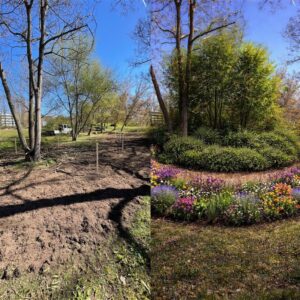
Image description 2: The image shows the current preparation of the ground area for the climate forest on the Nordhausen campus in contrast to an AI-generated vision (created with OpenAI DALL-E via ChatGPT) of its future, lush vegetation. While the main image documents the initial state in 2026, the embedded preview image illustrates the goal of a dense, flourishing ecosystem.
The climate forest
With the climate forest, the university is relying on a proven concept for natural campus design. Native trees and shrubs have been planted so densely in a small area that a real ecosystem is created in a very short time. The special feature: After a short growth phase, the forest regulates itself. It requires hardly any water or maintenance and offers birds and insects a valuable refuge in the centre of the campus. „Our campus is already green, but it needs to be better adapted to climate change, more drought, more extreme weather events and higher temperatures,“ says project manager Dr Pascal Leibbrandt, describing the measures.
For Nordhausen University of Applied Sciences, the focus is on the benefits in everyday life:
Natural air conditioning: On hot summer days, the forest provides noticeable cooling in the area through evaporation.
Oasis of well-being: The green area enhances the campus image and creates a new place to take a deep breath between lectures.
„Maintenance-free“: The dense planting suppresses weeds, which relieves the university's gardeners in the long term.
Active climate contribution: The ecological performance of the area is remarkable. While a typical mixed forest binds around one tonne of CO₂ per 1,000 m² per year, the Nordhausen climate forest already makes a measurable contribution on its area: by binding around 400 kg of CO₂ per year, the area mathematically offsets the emission value of around 200 litres of diesel
Intergenerational commitment: „Campus children“ lend a hand
A special highlight of the realisation was the active participation of the youngest campus residents. The children from the university's own day care centre „Campus Kinder“ supported the planting campaign with great enthusiasm. Together with those involved in the project, they planted the young trees in the ground and learnt through play how a protective forest grows from small seedlings.
Holistic campus transformation
The climate forest is part of Nordhausen University of Applied Sciences„ strategy to optimise resource flows in the “Energy and Operation„ sub-project of the KLIMA-N network. The forest is flanked by technical micro-projects. The climate forest is embedded in a series of practical micro-projects. The university is focussing primarily on the principle of “conservation and use". These developments and objectives go hand in hand with a climate-friendly campus design at Nordhausen University of Applied Sciences.
Synergy of PV and mobility: A reactivated photovoltaic system supplies renewable electricity for a new bicycle workshop in the former greenhouse, where e-bikes can be charged and serviced in future.
Wind power as a teaching aid: The wind turbine on campus was dismantled after a defect and underwent maintenance. It is primarily used as an object of visualisation for teaching purposes to enable students to understand wind power technology directly on site
Background: The KLIMA-N network
The „CLIMATE Network for More Sustainability in Thuringia“ (KLIMA-N) project brings together four Thuringian universities to make sustainable transformation a tangible experience on campus. Each partner institution contributes its specific expertise to the network: While Nordhausen University of Applied Sciences focuses on practical solutions for energy, operations and climate-friendly campus design, the University of Erfurt concentrates on developing innovative approaches to teaching and education for sustainable development (ESD). Erfurt University of Applied Sciences is developing forward-looking concepts for climate-friendly mobility and strengthening biodiversity. The TU Ilmenau closes the circle by networking the various projects and ensuring that the results are communicated throughout the region. The joint project is funded by the Federal Ministry of Research, Technology and Space (BMFTR).
You are currently viewing a placeholder content from Instagram. To access the actual content, click the button below. Please note that doing so will share data with third-party providers.
You are currently viewing a placeholder content from YouTube. To access the actual content, click the button below. Please note that doing so will share data with third-party providers.





Study Service Centre
+49 3631 420-222
House 18, Level 1, Room 18.0105