


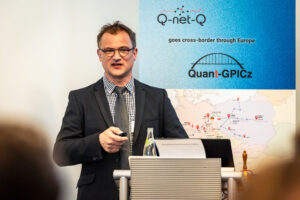


Photos: Cornelius Pfannkuch Film & Photography
2 June 2026
Nordhausen. Nordhausen University of Applied Sciences leads international consortium to establish a highly secure communication axis between Germany, Poland and the Czech Republic / Strategic contribution to Europe's digital resilience and sovereignty. Today's kick-off event marked the official launch of the QUANT-GPlCz - QKD Network Germany-Poland-Czech research project. The project marks a turning point in European cyber security: for the first time, national quantum communication infrastructures (QCI) will be linked to form a trilateral backbone.
Photos: Cornelius Pfannkuch Film & Photography
Successful foundation through predecessor project Q-net-Q
QUANT-GPICz builds directly on the results of the predecessor project Q-net-Q, which was also led by Nordhausen University of Applied Sciences. Several fibre optic test routes have already been successfully established as part of Q-net-Q, including the approximately 150 kilometre-long connection between Nordhausen and Erfurt. There are also test routes between Berlin and Frankfurt am Main with a length of around 670 kilometres and between Erfurt and Jena with a length of around 70 kilometres. While the focus there was on integrating quantum key distribution (QKD) into conventional networks and telemedicine applications, QUANT-GPICz is now extending this approach to an international level.
Strategic contribution to digital sovereignty
The project contributes to the realisation of the Federal Government's goals in the areas of cyber security and technological leadership. By establishing tap-proof data paths between government agencies, critical infrastructure and Internet nodes, QUANT-GPICz secures basic digital services. This is in line with the guidelines of the Coalition Agreement 2025, which prioritises digital resilience, as well as the European EuroQCI initiative.
Technological milestones: The backbone of Europe's digital sovereignty
A central focus of QUANT-GPICz is on overcoming national borders by establishing a trilateral quantum infrastructure. To this end, new QKD (Quantum Key Distribution) backbone connections will be realised, physically linking the metropolises of Frankfurt am Main, Warsaw, Berlin and Prague. This expansion will merge the existing national quantum networks - the German Q-net-Q, the Polish PIONIER-Q and the Czech CZQCI - into an integrated, cross-border network.
In parallel to infrastructural networking, research is focussing on the integration of critical sectors. In collaboration with DE-CIX, the world's leading internet and cloud exchange operator and interconnection service provider, highly secure private interconnections and connectivity solutions are being tested in order to raise data exchange between data centres to a new level of security. The practical application possibilities extend to highly sensitive areas of basic public and commercial services: specific concepts are being developed to secure transmission networks for the European energy supply as well as for the confidential communication of state institutions, such as the German Federal Printing Office.
Another unique technological feature of the project is the coupling of terrestrial networks with the space segment. By synchronising the fibre optic network with optical ground stations, QUANT-GPICz creates the necessary interfaces for the future EuroQCI space segment. This hybrid approach enables continuous, quantum-secure communication over long distances and strengthens European cyber defence. It forms the basis for a loss-free and protected exchange of information between the Security Operation Centres (SOCs) of the participating EU member states.
A strong European consortium: an alliance of science and industry
The successful implementation of this complex project is based on the close cooperation of a broad-based consortium under the coordination of Prof Dr Thomas Hühn, project manager and consortium leader at Nordhausen University of Applied Sciences. On the German side, the project brings together the expertise of leading research institutes - including the Fraunhofer IOF Jena, Fraunhofer HHI Berlin and Fraunhofer IIS, Adaptive Systems Development Division, as well as the Technical Universities in Berlin and Munich. Innovative industry players such as the interconnection service provider DE-CIX and Quantum Optics Jena GmbH are also involved.
This national expertise is complemented by strong partners from Poland and the Czech Republic, such as the Institute of Bioorganic Chemistry (PAS), NASK, Politechnika Wrocławska and the Czech Technical University in Prague.
The consortium is also supported by a network of associated partners from the field, including the German Research Network (DFN), Gasline GmbH & Co. KG, Bundesdruckerei GmbH and Thüringer Netkom. Together, these players are pooling their resources to accelerate the market maturity of quantum communication technologies and set European security standards.
About QUANT-GPICz
The project combines physical security through quantum mechanics with modern network planning in order to strengthen Europe's technological independence. QUANT-GPICz has a total budget of around 18 million euros. It is being funded as part of the European EuroQCI initiative, with 50 % each from the European Union and the German Federal Ministry for Digital and State Modernisation (BMDS).

Caption: Quant-GPICz QKD & IT topology
Share:
Technical employee
+49 3631 420-151
Building 12 (ground floor)
Head of University Marketing
+49 3631 420-113
Building 12 (ground floor)
Inclusion officer, website administrator / technical management
+49 3631 420-114
Building 11, Room 11.0105
You are currently viewing a placeholder content from Instagram. To access the actual content, click the button below. Please note that doing so will share data with third-party providers.
More InformationYou are currently viewing a placeholder content from YouTube. To access the actual content, click the button below. Please note that doing so will share data with third-party providers.
More Information


Study Service Centre
+49 3631 420-222
House 18, Level 1, Room 18.0105