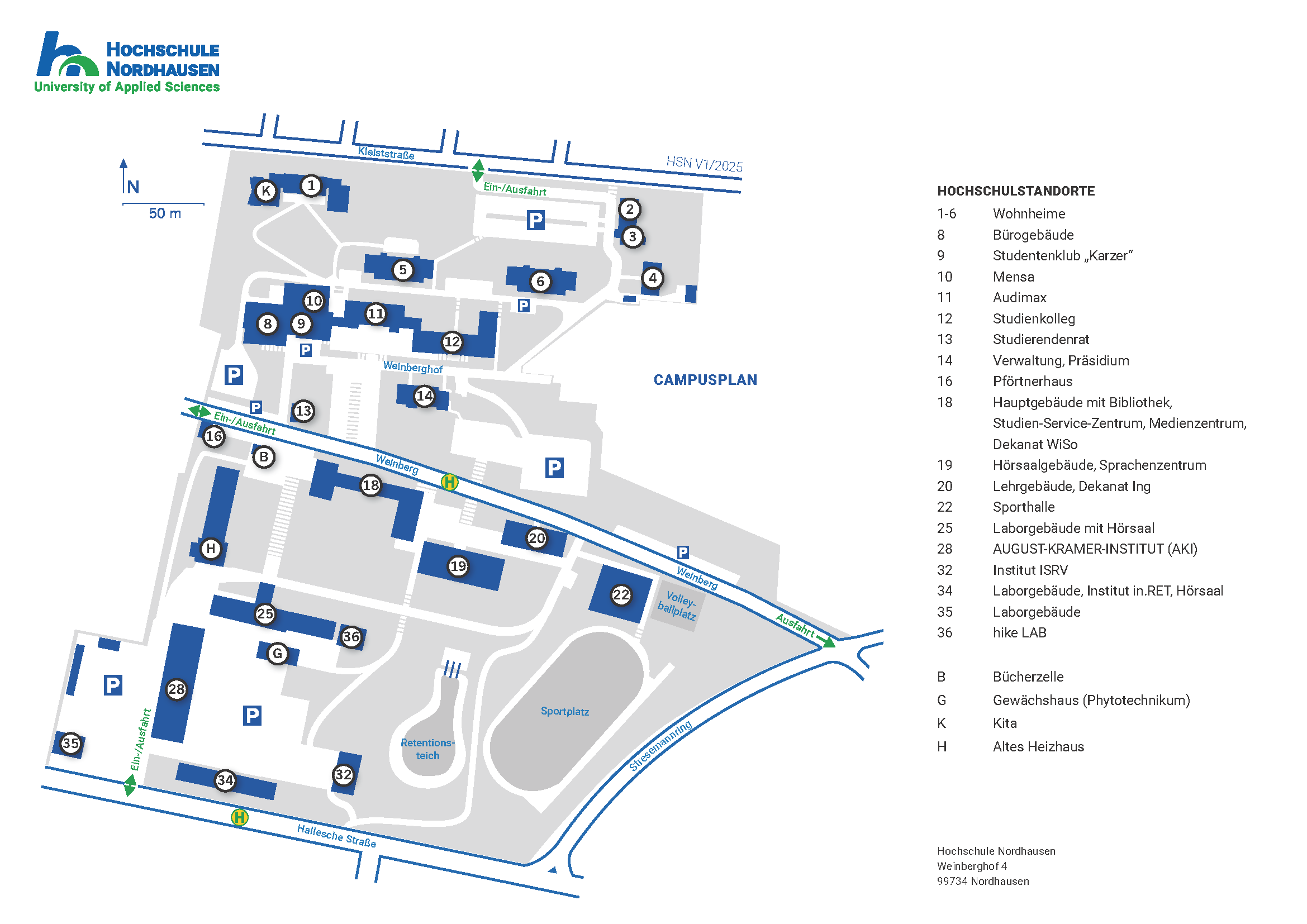
The Institute for Public Management and Governance is a scientific institution of the Faculty of Business, Economics and Social Sciences at Nordhausen University of Applied Sciences1 and as such aims to sharpen its profile in the field of administrative sciences in the region, but also nationwide. In addition to pooling existing expertise, the aim is also to strengthen the recognised research focus on "Management and Governance"2The interdisciplinary research on management problems, innovation and change processes as well as control and regulatory structures in the state, economy and society.

In the region, our institute supports local authorities and their public companies across the federal states. We are also familiar with the situation of medium-sized and smaller municipalities, particularly through the practical phases of our students. Their challenges in shaping and maintaining public tasks are the starting point for our research and work programme entitled "Decision-making in local authorities - overcoming challenges better"3.

It is not always easy to identify the legal room for manoeuvre for politicians and administrators due to the framework conditions that affect all policy areas: These include spatial, economic and demographic developments as well as a budgetary and financial situation that can only be partially influenced4. Demographic developments, for example, have clear consequences for the fulfilment of public tasks:

How can we respond effectively to declining population figures, the exodus of young people and the resulting increase in the average age in all areas of municipal activity without jeopardising the fulfilment of public tasks?5 Due to these challenges, municipal stakeholders should strategically shape policy and adapt their structures. "Deciding" makes it clear that it is not possible to respond to a complex environment solely by modernising local government internally6. In recent years, not only have citizens' expectations of politics and administration changed (individualisation; sustainability), but the effectiveness of these modernisation concepts is being questioned both within and outside of administrative organisations. Better decisions orientated towards the changed environmental conditions therefore take greater account of the legitimacy, effectiveness and efficiency of government and administrative action.7 

The control and regulatory structures that the Institute then takes up for further design focus on the situation "on the ground" and do not only refer to the meta or macro perspective.8 We are interested in solutions to practical management problems: whether a public task should continue to be fulfilled and how fulfilment can be achieved in the "network of municipalities".9 can be improved. In order for municipal actors to be able to shape policy in this sense, management is understood institutionally10However, solutions to practical management problems are relevant for the decision-makers of an organisation. For design recommendations, it is necessary to continue to focus functionally - and thus independently of the actors - directly on the tasks that must be fulfilled to control the performance process11.

In order to be able to make recommendations for overcoming current challenges, the Institute utilises its Qualifications in the fields of law, economics and social sciences: We analyse your management problem from different perspectives and identify and evaluate possible options for action in a comprehensible manner.


  1. See § 37 para. 1 ThürHG.
  2. According to the structural and development planning of Nordhausen University of Applied Sciences, this research focus includes "interdisciplinary research on management problems, innovation and change processes as well as control and regulatory structures in the state, economy and society".
  3.  In rural regions as a whole, but particularly in peripheral areas such as along the former inner-German border, for example, the consequences of demographic change become apparent more quickly and more clearly (cf. Advisory Council on Spatial Planning 2009, p. 2 f.).
  4. Furthermore, institutional factors such as the legal structure of the budget emergency regimes by the federal states or the municipal constitution could be taken into account (see Bogumil/ Holtkamp 2013, p. 60 ff.) In addition to the (re-)municipalisation of tasks, Wollmann also sees the increasing number of requirements by the state and federal level (and the EU) as a growing challenge (Wollmann 2012, p. 438).
  5.  The demographic development is also seen by Thuringia's state politicians as a central challenge for the future viability of the municipalities. As a particularly affected federal state, political planning is based on four central theses: 1. the future will bring competition between regions 2. politics and administration must move away from thinking in terms of administrative units and think and act in a cooperative, integrative and cross-border manner. 3. in rural areas in particular, it is important to utilise and develop all potential. 4. the central place system will gain in importance as a concept for the provision of services of general interest in rural areas (cf. Eib/ Braun 2014, p. 14 f.). Further consequences of demographic change are: increasing demand for health and care services, succession problems, e.g. in retail, medical care and commercial enterprises, increasing housing vacancies and fewer opportunities for qualification in the region (cf. Rechlin et al. 2010, p.6 f.).
  6. On internal modernisation, cf. the criticism of the new management model by Bogumil et al. 2007.
  7. New Public Management emphasises efficiency and effectiveness (see Schedler/Proeller 2011, p. 57 f.). However, "decision-making in the municipalities" is also caught between the poles of "economic and state-political rationality": even when making decisions at municipal level, the seemingly irreconcilable poles of "neoliberal individual benefit maximisation" and the "justice- and consensus-oriented" understanding of the state in democratic societies must be weighed up again and again (cf. Thom/ Ritz 2008, p. 31 f.).
  8. There are some approaches to local policy research that also see themselves as administrative research. Although the relationship between council, administration and mayor is central to this, the consideration of municipalities as an "independent arena of political debate and problem-solving strategies" is still a desideratum of research (cf. Zimmermann 2012, p. 283 f.). Governance approaches are interesting for analysing such issues (cf. e.g. Fürst 2007, p. 358). Different options for action in municipal policy arise, for example, in the fields of local infrastructure policy, economic development, but also in social policy with regard to the organisation of services prescribed by law at higher levels (cf. Häußermann et al 2008, p. 340f.). Management concepts deepen one possible perspective. Strategic management (cf. Schedler/Siegel 2004) could also be used to develop suitable control and regulatory structures for local authorities in order to recognise context dependencies. In order to be able to make operational and strategic recommendations within this framework, structural framework conditions and (social) impact chains of the relevant environment must also be analysed for "governance in municipalities".
  9.  According to Reichard 2004, p. 57 f., cooperative, competitive or mixed forms are also chosen at municipal level to fulfil public tasks. He describes this "institutional entanglement" as a network in which a centre is responsible for several client-contractor relationships for the production of services for citizens. The KGSt refers to such control and regulatory structures as the "municipal group" (KGSt 2012, p. 10 f.). From a political science perspective, Kersting, for example, adds that "good local governance" is not only effective and efficient service production, but also enables greater participation and transparency through greater involvement of civil society (cf. Kersting 2004, p. 35).
  10. The Institute is guided by the principles of New Institutional Economics, whose assumptions largely coincide with behavioural economics: Scarcity of resources as a social fact, methodological individualism and behavioural orientation and control to or through institutional regulations (cf. Schanz 2014, p. 124f.).
  11.  Cf. Steinmann/Schreyögg 2005, p. 6: In terms of processes, management can be roughly divided into the phases of planning, implementing and controlling. Today, this perspective includes not only the division of labour according to Taylor (scientific management), but also system-oriented, situational and decision-theoretical approaches (cf. Staehle 1999, p. 81). Thus, not only interaction within the organisation, but also interaction with the environment and reaction to changing environmental conditions become the object of design (cf. Reichard 2002, p. 60 ff.).

As part of our research and work programme, we are currently mainly working on projects that can be thematically assigned to the following fields of action:

  • Business management tools for successful administrative action
    • including budget consolidation, long-term personnel planning, process optimisation
  • Regional development
  • Knowledge, effectiveness & sustainability
  • Leadership in the public sector & digitalisation
  • Administrative Marketing, Innovation & Social Entrepreneurship

Receive support!

You have a practical problemthat you need support in solving? Then send us an e-mail to .