


1 September 2025
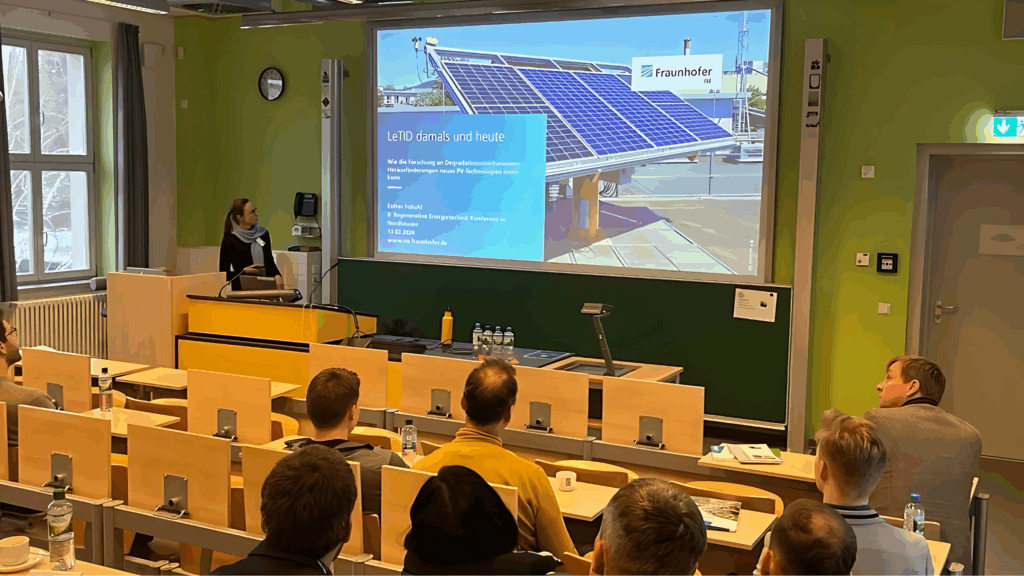
Esther Fokuhl's dissertation on the reliability testing of photovoltaic modules in connection with light-induced degradation has been published in the Nordhausen University of Applied Sciences publication series.
Introduction
Together with wind power, solar energy will be the central pillar of a future energy system. In the last twenty years, photovoltaics has been characterised by rapid technological developments in the field of cell and module construction and production. On the one hand, this has led to a significant drop in prices; on the other hand, only a few technologies have long-term experience in the field. Although photovoltaic modules are permanently exposed to the weather, a technical service life of at least 20 years is expected. This is also the basis for the performance guarantee granted by the manufacturers or for the calculation of a cost-covering feed-in tariff.
The long period of time and environmental influences cause the materials used to age naturally. In addition, there are degradation phenomena that are induced by the cell technology and intensified by environmental influences. These degradation phenomena are a comparatively young field of research in which a state model of the degradation behaviour is established on the basis of an electrical understanding of the degradation mechanisms and valid module tests are derived from this.
As part of her work, which was made possible by a collaboration between Nordhausen University of Applied Sciences, Dresden University of Technology and the Fraunhofer Institute for Solar Energy Systems in Freiburg, Dr.-Ing. Esther Fokuhl focused on the light-induced degradation behaviour of crystalline silicon solar cells. She succeeded in developing a fundamental understanding of the degradation behaviour and verifying it experimentally. The results of her work have a significant impact on the design and implementation of test standards.
Methodology
Light-induced degradation is a comparatively new subject of research in the scientific debate, which, like TCO corrosion or potential-induced degradation, manifests itself at cell level. In addition to a number of other mechanisms, a distinction is made in particular between light-induced degradation by boron-oxygen compounds (BO-LID | boron-oxygen related light-induced degradation) and light and temperature-induced degradation (LeTID | light and elevated temperature induced degradation). Different processes occur simultaneously in both BO-LID and LeTID. Both degeneration mechanisms can be described by state models that describe the transition between degeneration, annealing or recovery processes and regeneration. The challenge in developing valid test methods to determine the sensitivity of cell technologies to the two degeneration mechanisms now lies on two levels: On the one hand, a test sequence must specifically excite certain states in order to reliably detect degradation. On the other hand, test sequences usually stimulate both BO-LID and LeTID equally, which makes it necessary to separate the influence of both mechanisms.
Ms Fokuhl's work addresses both challenges and shows what a reliable test method for light- and temperature-induced degradation (LeTID) could look like: Thus, suitable test conditions (Slow LeTID) were developed in conjunction with preconditioning of the modules. It was also shown that a further acceleration of the test procedure (Fast LeTID) leads to an increase in the inaccuracy of the test results. A stabilisation process was developed to separate the effect of BO-LID and LeTID, which leads to a temporary BO-LID regeneration and temporarily restores the LeTID degeneration. The procedures were first theoretically substantiated and then validated by extensive test sequences at module level.
Based on these findings, Ms Fokuhl investigates the influence of LeTID and BO-LID on photovoltaic systems under free-field conditions in the final part of her thesis and develops an energy-efficient method for LID recovery at generator level.
Results
In addition to the development of an effective test procedure, Ms Fokuhl's work allows an initial assessment of the sensitivity of crystalline silicon solar modules in the field: under real environmental conditions, temporary recovery plays a decisive role in the development of power losses due to LeTID. In locations with a temperate climate, such as Germany, temporary recovery significantly reduces the yield losses of PV power plants. Furthermore, the state change of temporary recovery can be applied to reverse LeTID in PV power plants through night-time current injection. Such a process has the potential to significantly reduce yield losses in PV power plants from the late 2010s, as a significant number of LeTID-sensitive PERC modules were installed during this period. Provided that suitable conditions can be guaranteed, an economically viable implementation of such a process is possible. Suitable conditions exist if (a) a pulsed current is used instead of a constant current; (b) a current in the range of the label short-circuit current is used; (c) the procedure is carried out during cold winter nights. It is likely that a periodic repetition of the procedure will be required, albeit with a lower energy input.
Ms Esther Fokuhl defended her thesis at TU Dresden in February 2025 and has now published it in the Nordhausen University of Applied Sciences publication series. The dissertation was awarded summa cum laude.
Esther Fokuhl: Photovoltaic Module Reliability Testing in the Context of Carrier-Induced Degradation. Nordhäuser Hochschultexte | Schriftenreihe Ingenieurwissenschaften Volume 7.
ISBN 978-3-940820-23-5 | https://doi.org/10.22032/dbt.67201
Prof. Dr Viktor Wesselak
Share:
Technical employee
+49 3631 420-151
Building 12 (ground floor)
Head of University Marketing
+49 3631 420-113
Building 12 (ground floor)
Inclusion officer, website administrator / technical management
+49 3631 420-114
Building 11, Room 11.0105
You are currently viewing a placeholder content from Instagram. To access the actual content, click the button below. Please note that doing so will share data with third-party providers.
More InformationYou are currently viewing a placeholder content from YouTube. To access the actual content, click the button below. Please note that doing so will share data with third-party providers.
More Information


Study Service Centre
+49 3631 420-222
House 18, Level 1, Room 18.0105