



23 April 2026
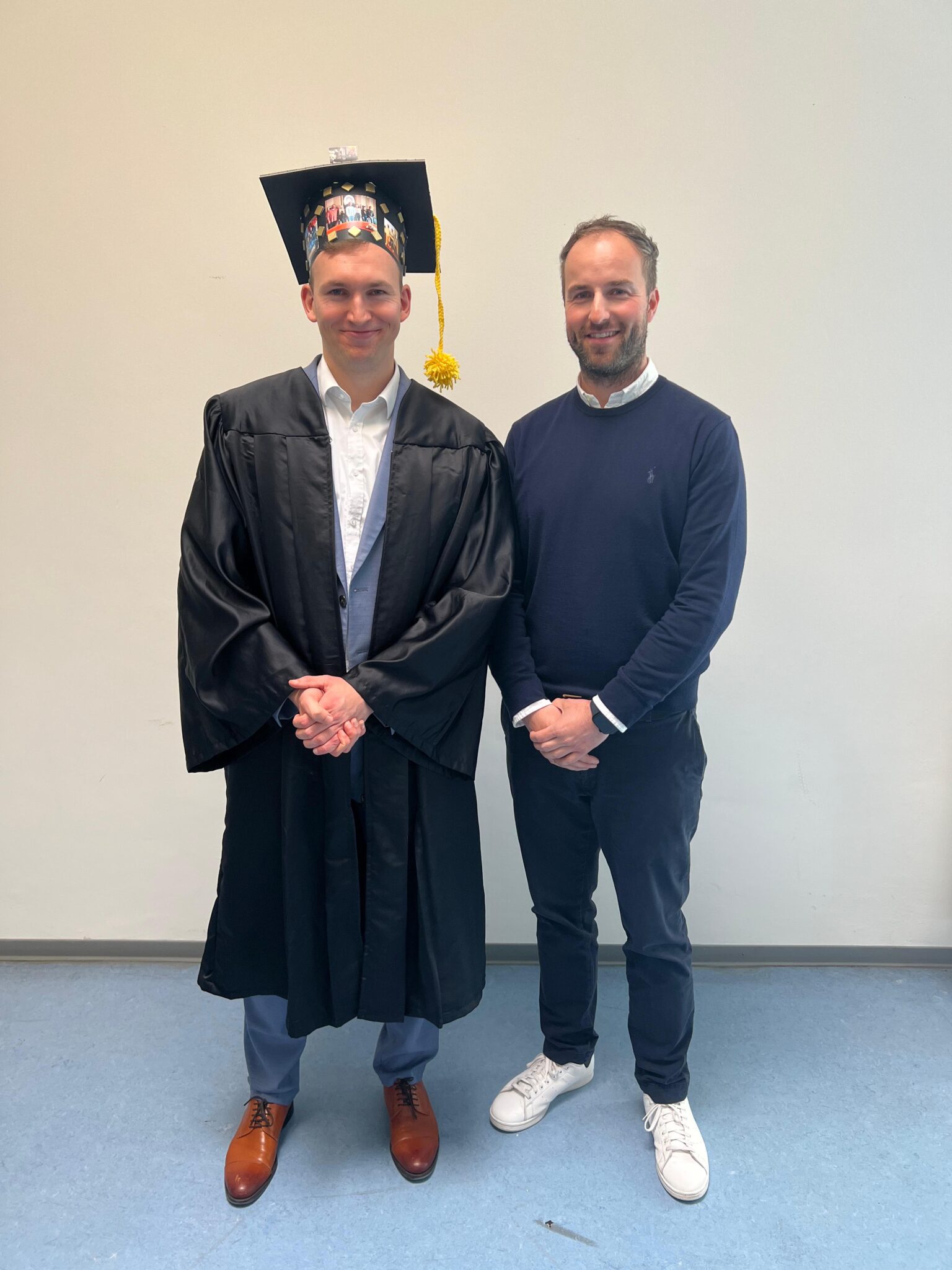
Nordhausen - Why do established companies fail to make radical changes, while others triumph despite having the same resources? Dr Max Schülting (alumnus of Nordhausen University of Applied Sciences/University of Jena) has investigated this question in his dissertation. His research dispels the preconception that success is only a question of budget. In his dissertation, the alumnus of the Innovation and Change Management programme investigated the conditions under which companies successfully innovate their business models - and when they fail to do so despite having the resources and skills to do so. The work was supervised by Prof Dr Matthias Menter, Friedrich Schiller University Jena, and Prof Dr Lutz Göcke, Nordhausen University of Applied Sciences.
The focus of the work is on business model innovation. Unlike a pure product innovation - such as the development of a new device - the focus here is on the ‚big picture‘: How does a company earn its money? Are services combined differently, new distribution channels utilised or radically new pricing models introduced? A classic example is the shift from selling software to subscription models (streaming). Such upheavals are vital for companies, but highly complex.
Why does business model innovation succeed in some companies, while it fails in others despite comparable resources and capabilities? Since 2016, the academic debate on this topic has increased significantly and yet there is a lack of empirically sound answers as to which factors really explain the emergence and success of business model innovation. Max Schülting addresses this gap in his dissertation, which he submitted to the Friedrich Schiller University Jena and defended with the top grade summa cum laude.
Resources, leadership and corporate culture as success factors
The work was recognised as cumulative doctorate which means that it is based on four independent scientific articles (papers). These contributions already underwent review processes during the research phase (Peer review), which emphasises the high quality and scientific relevance of the results.
Max Schülting's dissertation identifies specific conditions under which the transformation of business models succeeds. One of the key findings refutes a widespread assumption in practice: larger resource buffers do not automatically lead to more innovation.
A key finding of the study concerns the role of company resources. Contrary to popular belief, extensive resource buffers do not necessarily lead to a higher innovation rate. Rather, the decisive factor is the Resource fluidity - the ability to quickly release resources from existing uses and flexibly transfer them to new innovation projects. While low fluidity can inhibit both incremental and radical innovations, highly fluid resources favour radical changes to the business model in particular.
Another article shows that the Dimensions of dynamic capabilities - recognising opportunities, mobilising resources and adapting structures - have different effects depending on the form of innovation. While these skills have both an immediate and delayed effect on radical business model innovations, they only have a delayed effect on incremental (step-by-step) adjustments. This relationship is also significantly influenced by the dynamics of the respective corporate environment.
With regard to the composition of the Top management the work shows opposing effects: Longer management tenure favours incremental (business model) innovation. In contrast, moderate fluctuation within the management level and a high diversity of tenures favour the implementation of radical business model innovation.
In addition to structural factors, Schülting identifies the cultural dimension as a key influencing factor. A strong alignment of values, norms and goals between employees and the organisation (Person-Organisation-Fit) strengthens the impact of innovation capabilities. If this fit is weak, companies are less likely to succeed in translating their innovative strength into actual economic performance. Innovation capability is thus defined as a combined structural and cultural management task.
Formal excellence: quality assurance through international standards
The scientific relevance of the dissertation is emphasised by its cumulative form and the fact that the underlying research contributions have received multiple awards. In contrast to a classic monograph, the work consists of four independent scientific articles (papers), which already underwent international review processes during the doctoral phase.
The high quality of these contributions was confirmed by several prizes during the development process. For example, Max Schülting and Professors Dr Göcke and Dr Menter received the FGF Norbert Szyperski Technology and Innovation Management Award at the G-Forum 2024 for their study on the moderating effect of cultural fit (person-organisation fit) on innovation success. The work received further recognition at an international level: at the European Academy of Management (EURAM) 2025 conference, Schülting was honoured with the Best Paper Award from the Strategic Management section. In addition, his long-term analysis on the influence of top management team dynamics was honoured as Best Paper Runner-up at the R&D Management Conference 2025.
Alumnus of Nordhausen University of Applied Sciences
Max Schülting studied Innovation and Change Management at Nordhausen University of Applied Sciences, where he worked as a research assistant in the department during his studies. The dissertation was supervised by Prof Dr Matthias Menter, Friedrich Schiller University Jena, and Prof Dr Lutz Göcke, Professor of Business Administration, in particular Digital Management at Nordhausen University of Applied Sciences and Head of the hike University Incubator. Prof Dr David Bendig acted as second assessor. Since November 2025, Schülting has been working as a research assistant at the University of Münster, where he conducts research in the field of entrepreneurship and leads a European-funded third-party project.
Nordhausen University of Applied Sciences congratulates Max Schülting on this achievement and wishes him every success for his future academic career.
Share:
Technical employee
+49 3631 420-151
Building 12 (ground floor)
Head of University Marketing
+49 3631 420-113
Building 12 (ground floor)
Inclusion officer, website administrator / technical management
+49 3631 420-114
Building 11, Room 11.0105
You are currently viewing a placeholder content from Instagram. To access the actual content, click the button below. Please note that doing so will share data with third-party providers.
More InformationYou are currently viewing a placeholder content from YouTube. To access the actual content, click the button below. Please note that doing so will share data with third-party providers.
More Information


Study Service Centre
+49 3631 420-222
House 18, Level 1, Room 18.0105