


Marketing textbook, chapter 3
Consumer behaviour → Mental processes → Activating processes → Motivations (Chapter 3.4.1.3)
In consumer behaviour research, an approach has become established that serves to analyse the relationships between objectively existing product characteristics on the one hand and product characteristics perceived subjectively by consumers and associated with certain benefits on the other.
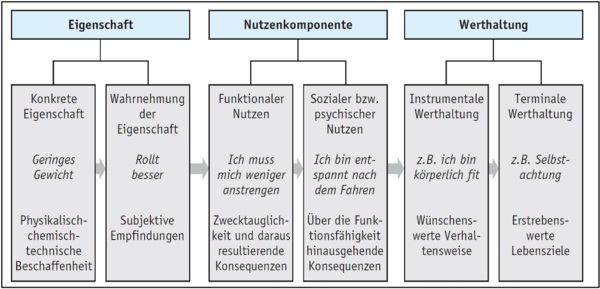
The central hypothesis of the so-called „Means End“ theory states that consumers see products (service bundles) as means to achieve values or goals („ends“) (Gutman, 1982, p. 60 ff.; Reynolds/Gutman, 1988, p. 11 ff.). The theory assumes that individual „means-end“ chains exist, which represent the hierarchically organised knowledge structures of consumers. The chains reflect the product perception and product evaluation process at different levels of abstraction (Herrmann/Huber, 2000, p. 13 f.). As shown in Figure 1, the chain runs from concrete, objective product features of a trekking bike (e.g. „low weight“) to increasingly abstract, subjectively perceived product attributes derived from these features (e.g. „rolls better“), the resulting benefits for the consumer („I have to exert myself less“) and the associated values („I am physically fit“).
The semi-qualitative laddering technique, which essentially consists of three steps, is used to record individual „Means End“ chains. Firstly, data is collected as part of a personal interview. The respondents are first given the task of selecting the product features relevant to their purchase decision. This can be done by means of a triad comparison or by forming a preference ranking for different products, with questions then being asked about the distinguishing features or the reasons for the judgement made. The second step involves the direct individual recording of the »Means End« chains. The respondents are asked to form a chain of abstraction based on a specific product feature by repeatedly asking them about the reasons for an expressed opinion. The concrete or objective characteristics therefore form the basis for the actual laddering process with the question: „Why is this characteristic important to you?“ The question of „why“ is repeated until the interviewee can no longer give an answer because they have arrived at a value attitude that is relevant to them and cannot be questioned any further.
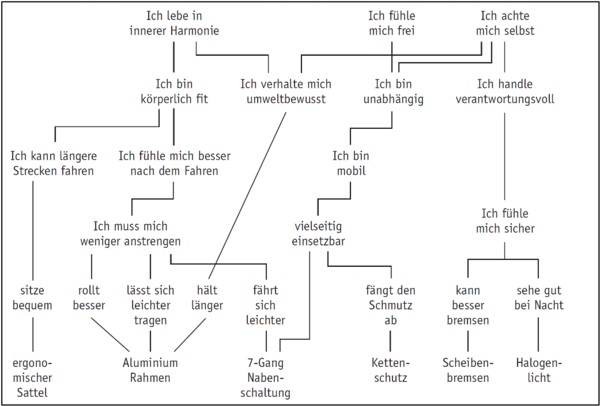
After analysing the responses from various respondents, the third step is the graphical preparation in the form of a so-called „Hierarchical Value Map (HVM)“. In a tree-like structure, the relationships between the most important product features and the resulting consequences and derivable values are depicted. Figure 2 shows an example of such an HVM based on a study carried out by Lemser and Scharf (2004) for the product „bicycle“. The graphical representation provides a better understanding of the relationships of interest.
In marketing practice, this information is also used to create a segmentation according to consumer needs and values as well as a segment-specific service programme. The findings are also suitable for planning effective advertising measures that tie in with consumers' personal values and link the advertised products to these values.

Additional material for the individual chapters:
3-2: Telecoms advertising - importance of mirror neurons for emotional reactions
3-4: Measuring implicit attitudes using the implicit association test (IAT)
3-6: Subjective perception: Are two tables identical or not?
3-7: The eye eats too: Visual perception influences our feeling of hunger
3-8: Febreze: Importance of habitualised decisions for marketing
4-2: Operationalisation and measurement of the environmental orientation of EU citizens
4-5: Screening questionnaire for the realisation of a predefined sample
4-6: Conception of an interview guide for a qualitative survey
4-7: Observation of individual eating behaviour in the „restaurant of the future“
4-8: Product positioning: Positioning a smartphone brand in the competitive environment
4-9: Testing the preference effect of smoothie properties using choice-based conjoint analysis
7-1: Kindle Fire - Influencing the perception of net benefit through advertising
7-2: Determining the optimal electricity tariff using choice-based conjoint analysis
7-4: Influencing perceived price favourability through umbrella pricing
7-7: High attractiveness of private financing and leasing offers for cars
8-1: Product positioning: Code analysis of the brand presence of two sparkling wine brands
8-12: Advertising impact analysis of digital communication tools
8-3: The power of megatrends and the future of safety and quality
8-5: Guerrilla communication: using a neo-Nazi march for a good cause
8-7: Integrated communication using the example of the Hypoxi brand
You are currently viewing a placeholder content from Instagram. To access the actual content, click the button below. Please note that doing so will share data with third-party providers.
More InformationYou are currently viewing a placeholder content from YouTube. To access the actual content, click the button below. Please note that doing so will share data with third-party providers.
More Information


Study Service Centre
+49 3631 420-222
House 18, Level 1, Room 18.0105