


Marketing textbook, chapter 8
Communication policy → Communication policy instruments → Paid media communication instruments → Online advertising (section 8.2.2.2)
For many companies, social media communication is a central instrument of their brand communication. Such campaigns are particularly successful - and therein lies their true value - when companies know how to utilise the attention and reach of a campaign in the long term. The campaign in connection with the relaunch of the Old Spice brand is one of the most successful of all time.
At first glance, it's a funny advert. However, what happened afterwards is exciting: the company invited people to ask questions and set tasks for the Old Spice Man. Celebrities such as Demi Moore and the Starbucks brand also asked questions. Old Spice produced 180 video responses within two days and published them. The result was overwhelming:
The example of Berliner Verkehrsbetriebe (BVG) shows how public transport companies can use social media campaigns to get rid of their outdated image: In the past, passengers tended to view their relationship with the transport company as unappreciative and associated with an aging marriage without affection. The „declaration of love“ launched to the more than 1 million people transported daily under the hashtag #weilwirdichlieben was surprisingly well received. The regular content deals with customer concerns and current, relevant topics are creatively realised in the typical language of the „Berliner Schnauze“ with authentic visual content.
However, the problem with social media campaigns is that their progress cannot be controlled. There is therefore a risk of unintended negative image effects being achieved, as the example of a Nutella campaign in France shows.
„In spring 2015, Nutella invited its customers to write messages on Nutella labels on a website and then share pictures of the virtual Nutella jars they had labelled themselves via social networks: viral marketing with creative customer input. It was clear that some people would find it amusing to associate the soft, brown substance with excretory products. However, the manufacturer had taken precautions against this: for example, if you tried to write the word ‘Merdella‘ on the label, you would be politely informed that the message you entered was contrary to the terms of use: Of course Ferrero doesn't like it when its hazelnut cream is labelled ‘poo‘. Publicly, on the label, in the typical black and red font. Or as a ‘giant fart“. Or, somewhat more artfully, as 'Anusella' or 'Cacatella'." (http://sz-magazin.sueddeutsche.de/texte/anzeigen/43224/Klotellas-Riesenfurz).
DHL provides another example of an unsuccessful social media campaign: in July 2019, the shipping company DHL organised a photo competition in which customers could send in funny pictures relating to the delivery service. There were high-quality prizes to be won as an incentive, which is why the company expected happy snapshots to be sent in, e.g. when receiving parcels. These were then intended to positively improve the image of the delivery service. However, the company mainly received pictures showing DHL drivers blocking cycle paths, pavements, roads or driveways. This reinforced the already established prejudice that DHL delivery drivers were reckless and did not adhere to traffic regulations. The photo competition was therefore an embarrassment for the company and led to a poorer image (cf. Weste, 2020).
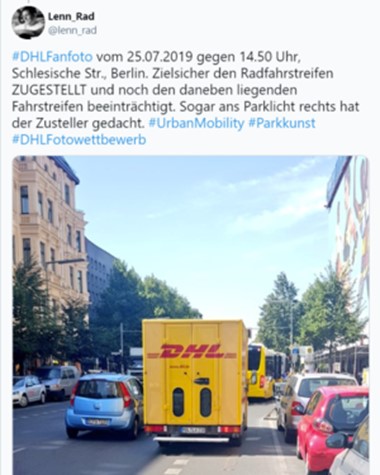
Screenshot of a critical Twitter post (today X) on the DHL photo competition: A photo shows a DHL van parked illegally in a cycle lane and obstructing traffic.
The screenshot documents the failure of a marketing campaign through user-generated content:

Additional material for the individual chapters:
3-2: Telecoms advertising - importance of mirror neurons for emotional reactions
3-4: Measuring implicit attitudes using the implicit association test (IAT)
3-6: Subjective perception: Are two tables identical or not?
3-7: The eye eats too: Visual perception influences our feeling of hunger
3-8: Febreze: Importance of habitualised decisions for marketing
4-2: Operationalisation and measurement of the environmental orientation of EU citizens
4-5: Screening questionnaire for the realisation of a predefined sample
4-6: Conception of an interview guide for a qualitative survey
4-7: Observation of individual eating behaviour in the „restaurant of the future“
4-8: Product positioning: Positioning a smartphone brand in the competitive environment
4-9: Testing the preference effect of smoothie properties using choice-based conjoint analysis
7-1: Kindle Fire - Influencing the perception of net benefit through advertising
7-2: Determining the optimal electricity tariff using choice-based conjoint analysis
7-4: Influencing perceived price favourability through umbrella pricing
7-7: High attractiveness of private financing and leasing offers for cars
8-1: Product positioning: Code analysis of the brand presence of two sparkling wine brands
8-12: Advertising impact analysis of digital communication tools
8-3: The power of megatrends and the future of safety and quality
8-5: Guerrilla communication: using a neo-Nazi march for a good cause
8-7: Integrated communication using the example of the Hypoxi brand
You are currently viewing a placeholder content from Instagram. To access the actual content, click the button below. Please note that doing so will share data with third-party providers.
More InformationYou are currently viewing a placeholder content from YouTube. To access the actual content, click the button below. Please note that doing so will share data with third-party providers.
More Information


Study Service Centre
+49 3631 420-222
House 18, Level 1, Room 18.0105