


Marketing textbook, chapter 9
To ensure delivery quality, a bicycle manufacturer prints a television on its dispatch boxes.
The delivery service is an important aspect of distribution policy to ensure customer satisfaction. It goes without saying that goods that are damaged during transport to the recipient do not meet the delivery quality expected by the consumer. The Dutch bicycle manufacturer VanMoof also exports its exclusive, high-priced bicycles to the USA after they have been ordered via the webshop. Each bike is packed in a large cardboard box and shipped in it. However, American courier drivers are not very squeamish when it comes to bicycles, meaning that one in four bikes arrives at the customer defective. As a result, the defective bikes have to be returned to Europe at great expense and a new bike has to be dispatched. Can nudging (see From Science 3-8) solve the problem?
Obviously yes: the transport boxes for the bikes are very large. They have the same dimensions as the packaging for an incredibly large and expensive television. In the USA, a television is much more important and valuable than any bicycle. Vanmoof therefore had a television set printed on the boxes. Within a very short space of time, complaints in the USA fell by 80 per cent. The reason: American courier services intuitively pay much more attention to a packaged television during transport than to a packaged bicycle. However, this nudging effect is also having a positive impact in other countries.
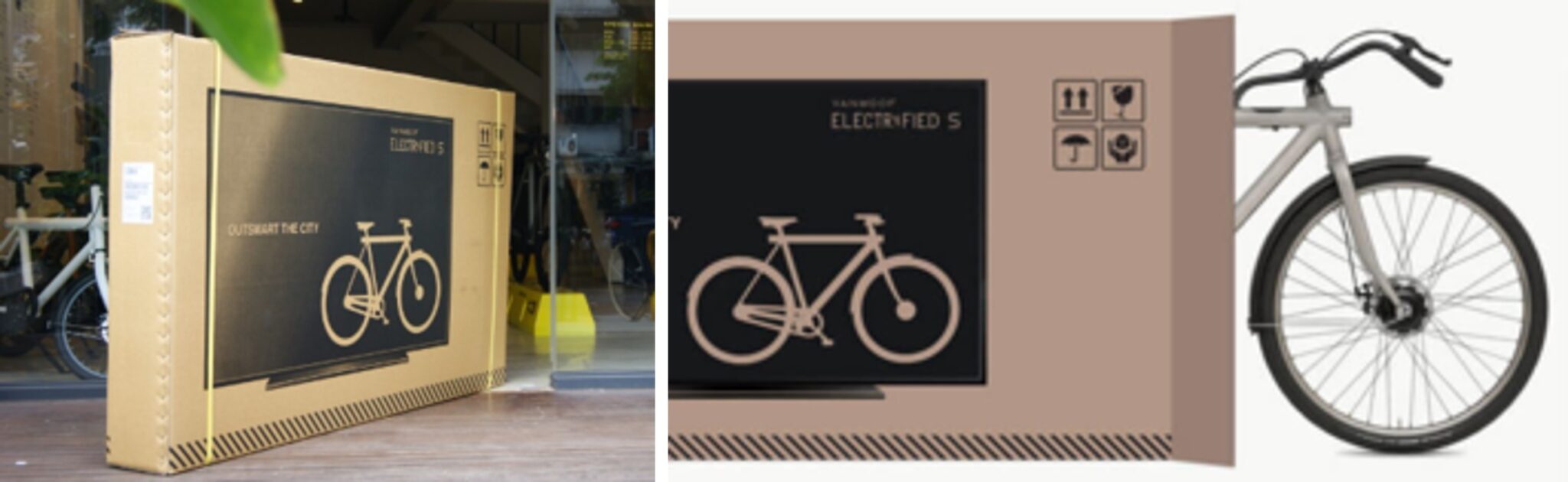
The illustration is divided into two parts to illustrate the concept:

Additional material for the individual chapters:
3-2: Telecoms advertising - importance of mirror neurons for emotional reactions
3-4: Measuring implicit attitudes using the implicit association test (IAT)
3-6: Subjective perception: Are two tables identical or not?
3-7: The eye eats too: Visual perception influences our feeling of hunger
3-8: Febreze: Importance of habitualised decisions for marketing
4-2: Operationalisation and measurement of the environmental orientation of EU citizens
4-5: Screening questionnaire for the realisation of a predefined sample
4-6: Conception of an interview guide for a qualitative survey
4-7: Observation of individual eating behaviour in the „restaurant of the future“
4-8: Product positioning: Positioning a smartphone brand in the competitive environment
4-9: Testing the preference effect of smoothie properties using choice-based conjoint analysis
7-1: Kindle Fire - Influencing the perception of net benefit through advertising
7-2: Determining the optimal electricity tariff using choice-based conjoint analysis
7-4: Influencing perceived price favourability through umbrella pricing
7-7: High attractiveness of private financing and leasing offers for cars
8-1: Product positioning: Code analysis of the brand presence of two sparkling wine brands
8-12: Advertising impact analysis of digital communication tools
8-3: The power of megatrends and the future of safety and quality
8-5: Guerrilla communication: using a neo-Nazi march for a good cause
8-7: Integrated communication using the example of the Hypoxi brand
You are currently viewing a placeholder content from Instagram. To access the actual content, click the button below. Please note that doing so will share data with third-party providers.
More InformationYou are currently viewing a placeholder content from YouTube. To access the actual content, click the button below. Please note that doing so will share data with third-party providers.
More Information


Study Service Centre
+49 3631 420-222
House 18, Level 1, Room 18.0105