


Marketing textbook, chapter 3
Consumer behaviour → Mental processes → Activating processes → Attitudes (Chapter 3.4.1.4)
The implicit association test (IAT) developed by Greenwald et al. (1998, p. 1464 ff.) is based on the principle of priming, whereby a distinction must be made between semantic and affective priming (Wittenbrink, 2007, p. 25 ff.).
Semantic priming means that individuals react more quickly to a word (e.g. „cow“) if a word with an associative connection (e.g. „milk“) was mentioned shortly beforehand. In comparison, the reaction time is longer if they have previously been confronted with a word without an associative link (e.g. „aeroplane“). This phenomenon is explained by activation by means of the associative link between the two words „cow“ and „milk“. Similarly, affective priming occurs when a person reacts faster because they were presented with a stimulus with the same valence (e.g. „beach“ = positive) before the stimulus to be evaluated (e.g. „sun cream“ = positive). The reaction time is correspondingly longer if the previously presented stimulus has a different valence (e.g. „dirt“ = negative). The evaluation of the IAT is based on the assumption that different reaction times when assigning terms to relevant attitude objects represent different attitudes (Lane et al., 2007).
The following example illustrates the ideal-typical sequence of the IAT: This involves the attitude of conservative East German consumers towards products of different origins. The results of the IAT provide reaction times that can be used to test the assumption that the test subjects have a more negative attitude towards products from West Germany than towards products from East Germany.
The test consists of the following five phases. By pressing the „A“ and „L“ keys, the test subjects have to categorise stimuli that either consist of a specific attribute (positive or negative terms) or belong to one of two target concepts that do not overlap (Eastern product or Western product).
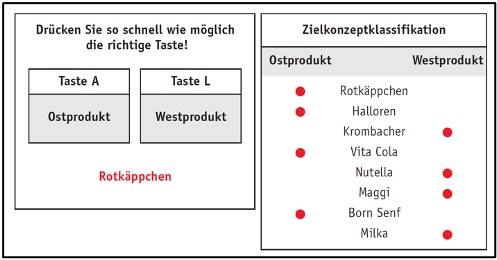
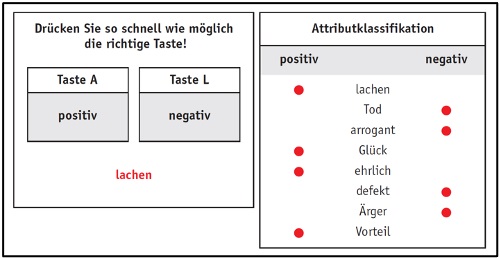
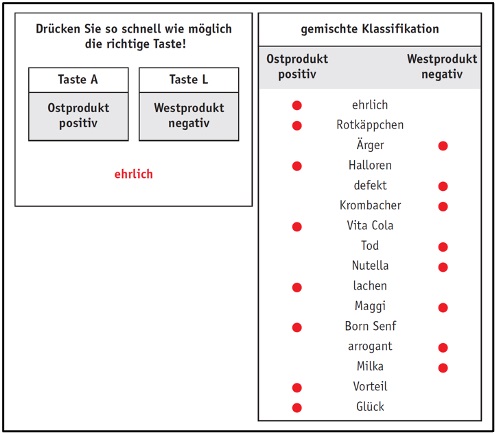


The evaluation is carried out by comparing the reaction times in the third phase with those in the fifth phase, as here the stimuli had to be assigned to the combinations of target concepts and attributes. This means that, due to the priming effect, there must be faster and slower reaction times in these two phases, depending on which combination in which phase corresponds more closely to the respondent's associations (Felser, 2015, p. 258 ff.). Normally, people react faster in the phase that has a compatible association for them, i.e. strong associations between attribute and target concept considerably simplify the correct assignment of a stimulus. Incompatibility between the two stimulus categories, on the other hand, leads to longer reaction times. A more positive attitude of the test subjects towards eastern products would therefore be noticeable in the difference in reaction time between the third phase (short reaction time) and the fifth phase (long reaction time). The IAT effect is therefore interpreted as a measure of the strength of associative links between the target concepts and the attribute values.

Additional material for the individual chapters:
3-2: Telecoms advertising - importance of mirror neurons for emotional reactions
3-4: Measuring implicit attitudes using the implicit association test (IAT)
3-6: Subjective perception: Are two tables identical or not?
3-7: The eye eats too: Visual perception influences our feeling of hunger
3-8: Febreze: Importance of habitualised decisions for marketing
4-2: Operationalisation and measurement of the environmental orientation of EU citizens
4-5: Screening questionnaire for the realisation of a predefined sample
4-6: Conception of an interview guide for a qualitative survey
4-7: Observation of individual eating behaviour in the „restaurant of the future“
4-8: Product positioning: Positioning a smartphone brand in the competitive environment
4-9: Testing the preference effect of smoothie properties using choice-based conjoint analysis
7-1: Kindle Fire - Influencing the perception of net benefit through advertising
7-2: Determining the optimal electricity tariff using choice-based conjoint analysis
7-4: Influencing perceived price favourability through umbrella pricing
7-7: High attractiveness of private financing and leasing offers for cars
8-1: Product positioning: Code analysis of the brand presence of two sparkling wine brands
8-12: Advertising impact analysis of digital communication tools
8-3: The power of megatrends and the future of safety and quality
8-5: Guerrilla communication: using a neo-Nazi march for a good cause
8-7: Integrated communication using the example of the Hypoxi brand
You are currently viewing a placeholder content from Instagram. To access the actual content, click the button below. Please note that doing so will share data with third-party providers.
More InformationYou are currently viewing a placeholder content from YouTube. To access the actual content, click the button below. Please note that doing so will share data with third-party providers.
More Information


Study Service Centre
+49 3631 420-222
House 18, Level 1, Room 18.0105