


Marketing textbook, chapter 5
Marketing objectives and marketing strategies → Development of marketing strategies → Market field strategies (section 5.2.1)
It is repeatedly claimed that the industry installs predetermined breaking points in its appliances in order to increase sales through earlier replacement. One However, an empirical study by the Öko-Institut and the University of Bonn found no evidence for this strategy of „planned obsolescence“.
Although the average lifespan of large household appliances (washing machines, tumble dryers, fridges) and computer hardware in German households has fallen in recent years, there is no evidence that manufacturers are deliberately building technical weaknesses into their products. Often the appliances are not defective when they are replaced, but are replaced because the functional benefits of new products are greater (e.g. better usability, lower consumption values).
Based on the current consumption habits of their customers and the technical possibilities, providers calculate the expected useful life of their products, which should therefore last as long as necessary, but not as long as possible. For example, two thirds of German citizens replace their mobile phones after three years at the latest because they want more storage space or a better camera, for example, or because a replacement is included in their mobile phone contract. This is why no manufacturer designs its smartphones for an average service life of ten years.
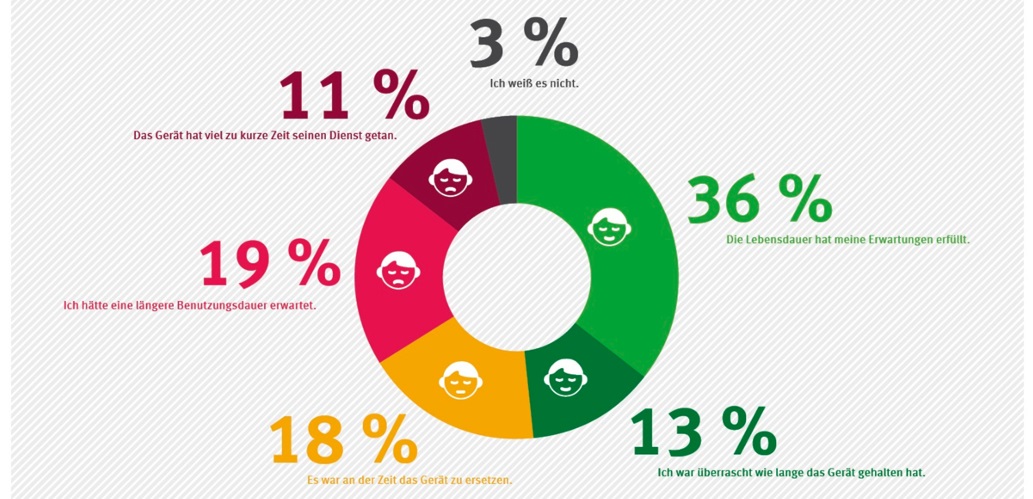
Many manufacturers of household appliances base the durability of their products more on the benefit expectations of their target groups. For example, some suppliers build washing machines that are extremely durable, while others launch particularly inexpensive products with a significantly shorter lifespan. The figure illustrates the results of a study by the Federal Environment Agency on consumer satisfaction with the service life of electrical appliances.

Additional material for the individual chapters:
3-2: Telecoms advertising - importance of mirror neurons for emotional reactions
3-4: Measuring implicit attitudes using the implicit association test (IAT)
3-6: Subjective perception: Are two tables identical or not?
3-7: The eye eats too: Visual perception influences our feeling of hunger
3-8: Febreze: Importance of habitualised decisions for marketing
4-2: Operationalisation and measurement of the environmental orientation of EU citizens
4-5: Screening questionnaire for the realisation of a predefined sample
4-6: Conception of an interview guide for a qualitative survey
4-7: Observation of individual eating behaviour in the „restaurant of the future“
4-8: Product positioning: Positioning a smartphone brand in the competitive environment
4-9: Testing the preference effect of smoothie properties using choice-based conjoint analysis
7-1: Kindle Fire - Influencing the perception of net benefit through advertising
7-2: Determining the optimal electricity tariff using choice-based conjoint analysis
7-4: Influencing perceived price favourability through umbrella pricing
7-7: High attractiveness of private financing and leasing offers for cars
8-1: Product positioning: Code analysis of the brand presence of two sparkling wine brands
8-12: Advertising impact analysis of digital communication tools
8-3: The power of megatrends and the future of safety and quality
8-5: Guerrilla communication: using a neo-Nazi march for a good cause
8-7: Integrated communication using the example of the Hypoxi brand
You are currently viewing a placeholder content from Instagram. To access the actual content, click the button below. Please note that doing so will share data with third-party providers.
More InformationYou are currently viewing a placeholder content from YouTube. To access the actual content, click the button below. Please note that doing so will share data with third-party providers.
More Information


Study Service Centre
+49 3631 420-222
House 18, Level 1, Room 18.0105