


Marketing textbook, chapter 9
Distribution policy Distribution policy → Physical distribution → Components and importance of the delivery service → Delivery time (chapter (9.3.2))
DHL trialled the delivery of urgent medicines to remote locations by parcel drone.
Logistics companies and internet groups such as Google and Amazon are developing and trialling the use of drones for parcel delivery. Even pizza delivery services are showing interest in using unmanned aerial vehicles to deliver orders. Companies are trying to use new technologies to organise the logistics sector much more efficiently, massively shorten delivery times and thereby increase customer benefits. In metropolitan areas, there are not only technical challenges but also very practical problems to be solved, e.g. in the public monitoring of automated air traffic, theft protection, economic efficiency or crash risks.
The logistics group DHL has therefore focussed on remote areas in order to test the use of parcel drones in pilot projects. To this end, DHL cooperated with RWTH Aachen University, which was responsible for the development, and the North Sea island of Juist, where the „Paketkopter“ ensured the emergency supply of urgent medicines to the island pharmacy. The advantage of using drones was that the delivery of medicines could be carried out at virtually any time, even in adverse weather conditions such as dense fog or darkness, in a short time and fully automatically over the distance of 12 kilometres between the mainland and the island, controlled by GPS. However, DHL had to register each drone flight to Juist individually, so the project was cancelled due to regulatory requirements and for cost reasons.
The last pilot project was carried out in 2018 under the name „Deliver Future“ with the Deutsche Gesellschaft für Internationale Zusammenarbeit and the drone manufacturer Wingcopter in Tanzania. The autonomously flying drone supplied the clinic on an island in Lake Victoria with medication from the mainland via fixed routes and took blood samples, for example, on the way back - all within 45 minutes on a route that can take up to six hours by car or boat.
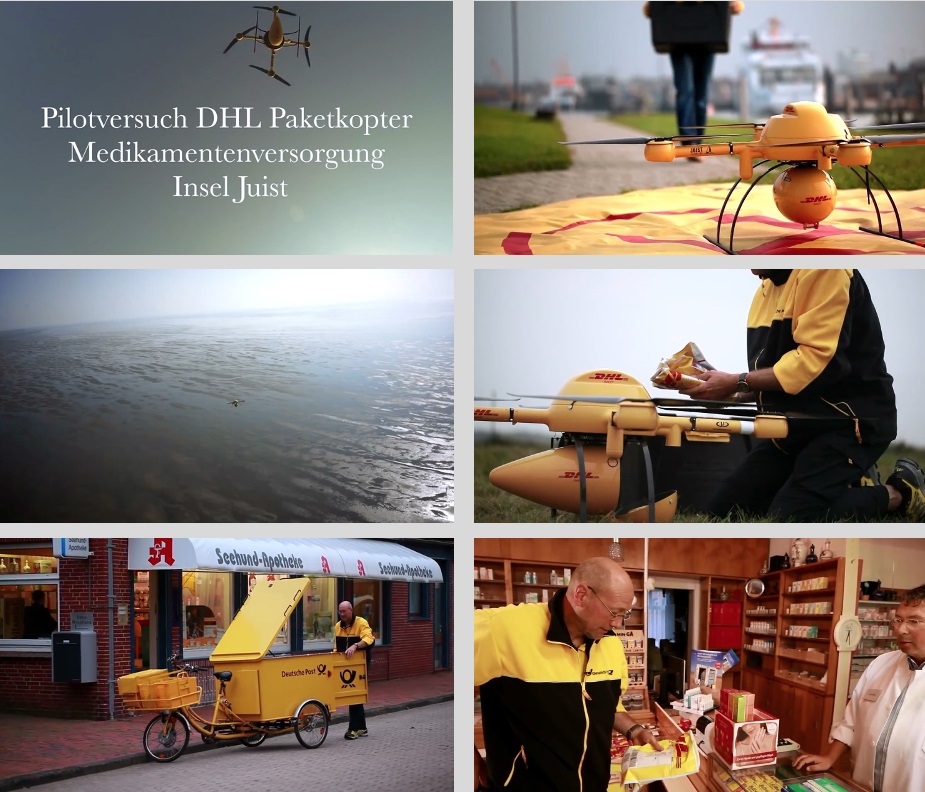
Photo series on the ‚DHL Paketkopter‘ pilot project: documentation of the autonomous delivery of medicines by drone from the mainland to the island of Juist.
The collage shows the drone logistics process in chronological steps:

Additional material for the individual chapters:
3-2: Telecoms advertising - importance of mirror neurons for emotional reactions
3-4: Measuring implicit attitudes using the implicit association test (IAT)
3-6: Subjective perception: Are two tables identical or not?
3-7: The eye eats too: Visual perception influences our feeling of hunger
3-8: Febreze: Importance of habitualised decisions for marketing
4-2: Operationalisation and measurement of the environmental orientation of EU citizens
4-5: Screening questionnaire for the realisation of a predefined sample
4-6: Conception of an interview guide for a qualitative survey
4-7: Observation of individual eating behaviour in the „restaurant of the future“
4-8: Product positioning: Positioning a smartphone brand in the competitive environment
4-9: Testing the preference effect of smoothie properties using choice-based conjoint analysis
7-1: Kindle Fire - Influencing the perception of net benefit through advertising
7-2: Determining the optimal electricity tariff using choice-based conjoint analysis
7-4: Influencing perceived price favourability through umbrella pricing
7-7: High attractiveness of private financing and leasing offers for cars
8-1: Product positioning: Code analysis of the brand presence of two sparkling wine brands
8-12: Advertising impact analysis of digital communication tools
8-3: The power of megatrends and the future of safety and quality
8-5: Guerrilla communication: using a neo-Nazi march for a good cause
8-7: Integrated communication using the example of the Hypoxi brand
You are currently viewing a placeholder content from Instagram. To access the actual content, click the button below. Please note that doing so will share data with third-party providers.
More InformationYou are currently viewing a placeholder content from YouTube. To access the actual content, click the button below. Please note that doing so will share data with third-party providers.
More Information


Study Service Centre
+49 3631 420-222
House 18, Level 1, Room 18.0105