


Marketing textbook, chapter 9
Distribution policy → Acquisition-based distribution → Organs of the direct distribution channel → Organisation of the distribution channels (chapter 9.2.1)
Digital music formats such as mp3 and streaming have changed the way music is used, so that the music industry has had to expand its distribution channels online in order to compensate for the decline in sales of traditional sound carriers.
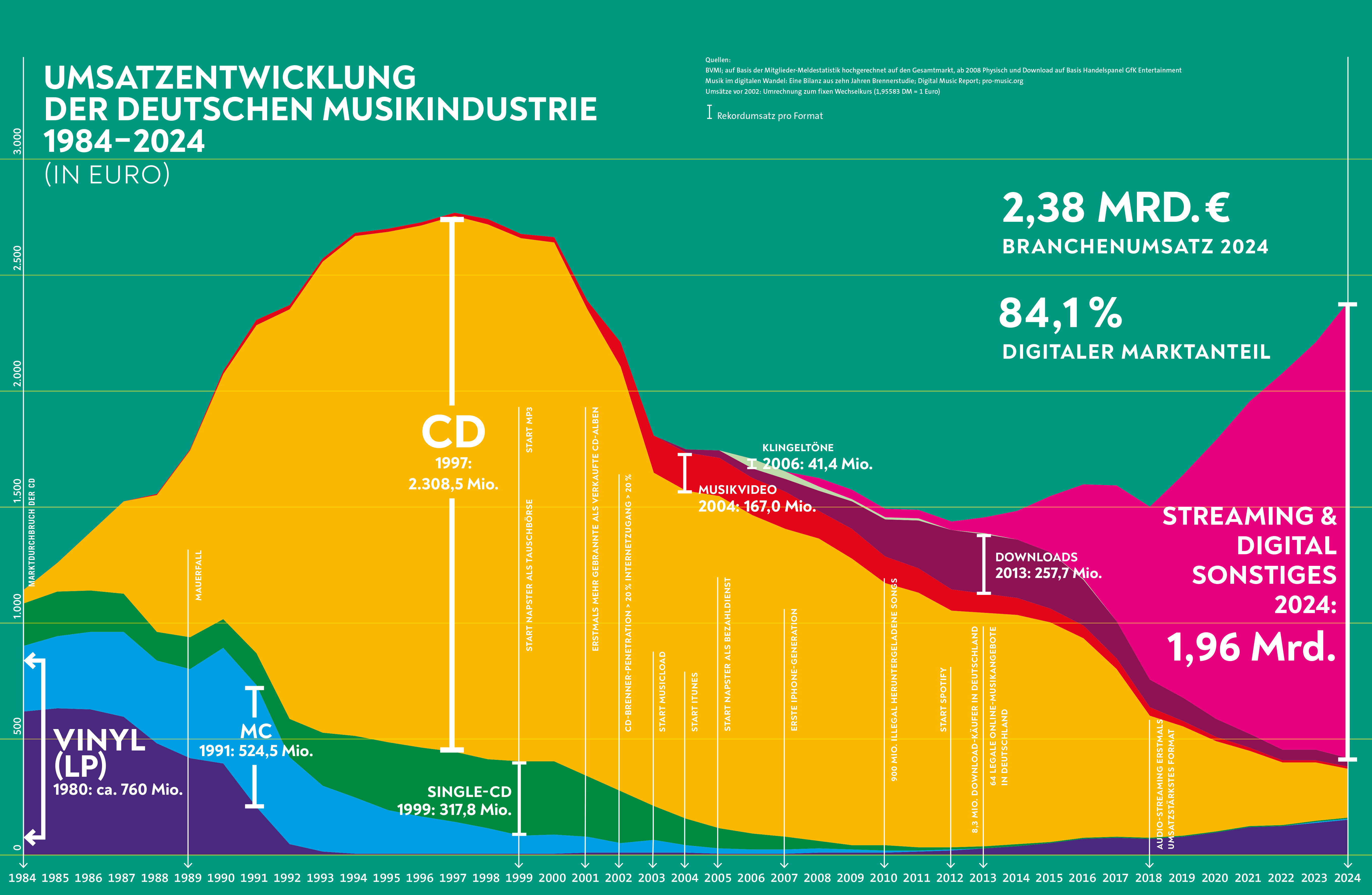
The example of the music industry shows that the decision to expand differentiated multichannel distribution can also be necessitated by technological environmental conditions (see chapter 2.2). With the spread of the mp3 audio file format at the end of the 1990s, music consumption behaviour began to change. While music had previously been listened to primarily via physical media (e.g. music cassettes, CDs, records), the mp3 compression format made it possible to listen to and exchange high-quality music files that required little storage space without the need for traditional sound carriers. While the German music industry's turnover peaked at 2.3 billion euros in 1997 with CDs alone, CD sales declined steadily with the launch of illegal music sharing networks on the Internet and the increasing penetration of CD burners and Internet access in the early 2000s. Only reluctantly did the music industry attempt to compensate for the collapsing sales by cooperating with new online distribution channels (Musicload, iTunes Store since 2003/2004). Parallel to the legal fight against music piracy, a legal channel for purchasing digital music was also created. In 2024, sales of CDs in Germany totalled just 210 million euros, while sales in the digital business (downloads, streaming services such as Spotify) rose to over 1.8 billion euros, 93 percent of which was attributable to audio streaming thanks to broadband internet access (Drücke et al., 2025, p. 9; Tschmuck, 2021, p. 191 ff.). Technological developments therefore changed consumer behaviour and made digital distribution and thus further differentiation of multi-channel distribution necessary in order to generate more revenue (Arditi, 2020, p. 23).
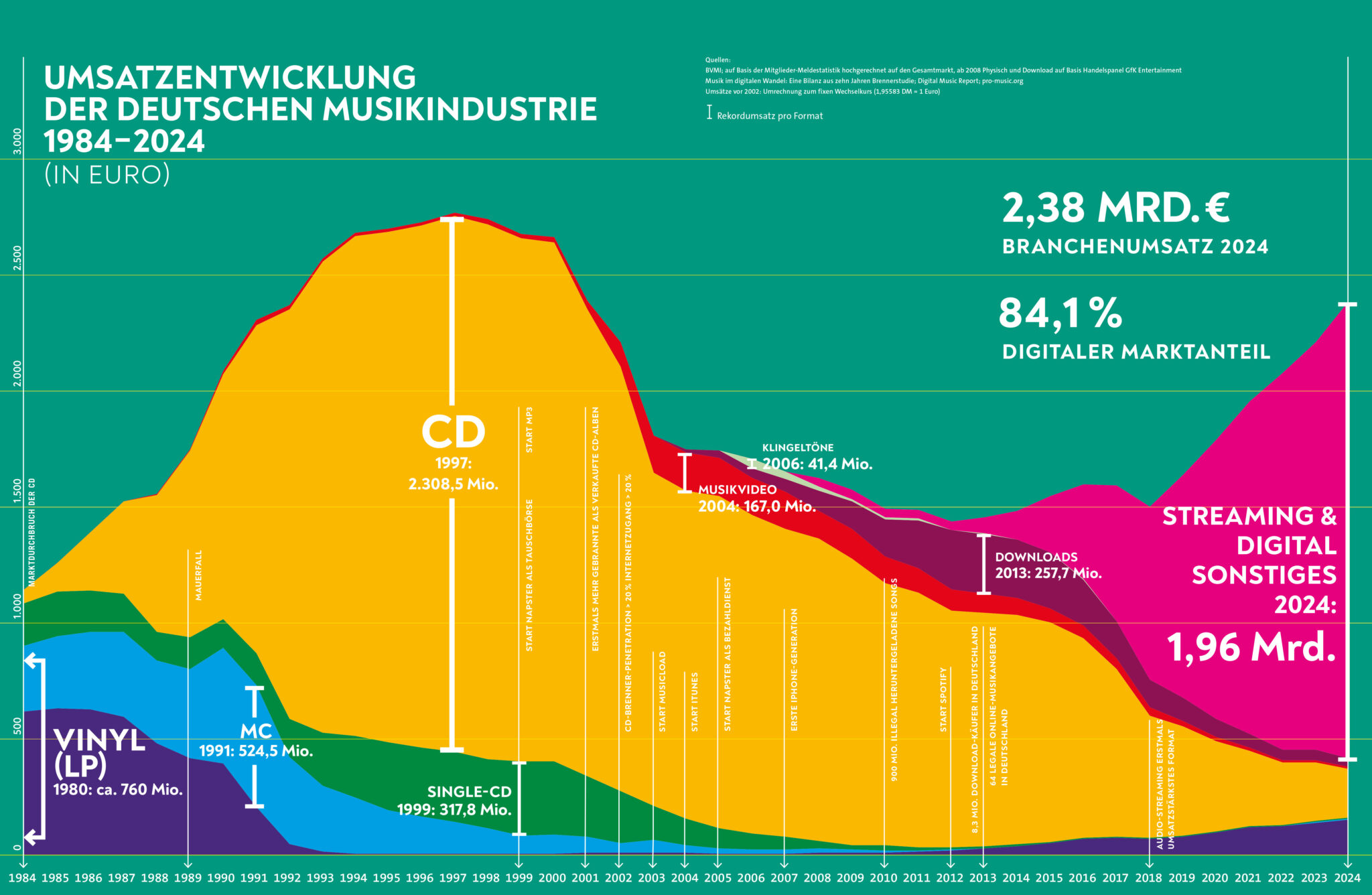
This complex infographic shows the change in music formats over four decades. Presented as a stacked area diagram, it shows the sales development of the German music industry (1984-2024) and thus the visualisation of the transition from analogue formats such as vinyl and MC through the CD era to the dominance of streaming and digital media in 2024.
The chart illustrates the massive structural change in the industry with colour-coded areas for the various sound carrier formats:
Milestones on the timeline: Important events are embedded in the chart, such as the fall of the Berlin Wall (1989), the launch of Napster as a file-sharing platform (1999), the launch of iTunes (2004), the first iPhone generation (2007) and the launch of Spotify in Germany (2012). 2018 marks the year in which audio streaming became the top-selling format for the first time.
Key figures 2024:
Revenue streaming & digital other: 1.96 billion.
Historical phases and formats:
Streaming & Digital Miscellaneous (Pink): This area will grow massively from around 2012 and will account for the lion's share of total sales in 2024.

Additional material for the individual chapters:
3-2: Telecoms advertising - importance of mirror neurons for emotional reactions
3-4: Measuring implicit attitudes using the implicit association test (IAT)
3-6: Subjective perception: Are two tables identical or not?
3-7: The eye eats too: Visual perception influences our feeling of hunger
3-8: Febreze: Importance of habitualised decisions for marketing
4-2: Operationalisation and measurement of the environmental orientation of EU citizens
4-5: Screening questionnaire for the realisation of a predefined sample
4-6: Conception of an interview guide for a qualitative survey
4-7: Observation of individual eating behaviour in the „restaurant of the future“
4-8: Product positioning: Positioning a smartphone brand in the competitive environment
4-9: Testing the preference effect of smoothie properties using choice-based conjoint analysis
7-1: Kindle Fire - Influencing the perception of net benefit through advertising
7-2: Determining the optimal electricity tariff using choice-based conjoint analysis
7-4: Influencing perceived price favourability through umbrella pricing
7-7: High attractiveness of private financing and leasing offers for cars
8-1: Product positioning: Code analysis of the brand presence of two sparkling wine brands
8-12: Advertising impact analysis of digital communication tools
8-3: The power of megatrends and the future of safety and quality
8-5: Guerrilla communication: using a neo-Nazi march for a good cause
8-7: Integrated communication using the example of the Hypoxi brand
You are currently viewing a placeholder content from Instagram. To access the actual content, click the button below. Please note that doing so will share data with third-party providers.
More InformationYou are currently viewing a placeholder content from YouTube. To access the actual content, click the button below. Please note that doing so will share data with third-party providers.
More Information


Study Service Centre
+49 3631 420-222
House 18, Level 1, Room 18.0105