


Marketing textbook, chapter 4
Market research → Decision problems in the context of data collection → Measurement theory basics (Chapter 4.2.2)
A survey was conducted on behalf of the European Commission to determine the attitudes of EU citizens towards the environment.
People aged 15 and over with the nationality of an EU member state and resident in one of the member states of the European Union were surveyed (survey subjects). Sampling was carried out using multi-stage random selection. The surveys were conducted as „face to face“ interviews with the selected persons in the respective national language. A total of 26,730 people were interviewed.
The characteristic to be measured was defined as „willingness to act in an environmentally oriented manner“ and the willingness to buy environmentally friendly products was identified as a suitable indicator, which was operationalised using the following question: „I am generally willing to buy environmentally friendly products, even if they are slightly more expensive than normal products.“ The measurement was carried out using a five-point interval scale (1 = don't know/no answer / 2 = strongly disagree / 3 = somewhat disagree / 4 = somewhat agree / 5 = strongly agree).
Three quarters (25 per cent strongly agree, 50 per cent somewhat agree) stated that they are willing to buy environmentally friendly products, even if they are slightly more expensive than normal products, while almost a fifth are unwilling to change their consumption habits in favour of the environment.
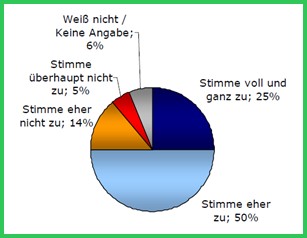
The diagram breaks down the response categories to the question of environmental orientation as follows:

Additional material for the individual chapters:
3-2: Telecoms advertising - importance of mirror neurons for emotional reactions
3-4: Measuring implicit attitudes using the implicit association test (IAT)
3-6: Subjective perception: Are two tables identical or not?
3-7: The eye eats too: Visual perception influences our feeling of hunger
3-8: Febreze: Importance of habitualised decisions for marketing
4-2: Operationalisation and measurement of the environmental orientation of EU citizens
4-5: Screening questionnaire for the realisation of a predefined sample
4-6: Conception of an interview guide for a qualitative survey
4-7: Observation of individual eating behaviour in the „restaurant of the future“
4-8: Product positioning: Positioning a smartphone brand in the competitive environment
4-9: Testing the preference effect of smoothie properties using choice-based conjoint analysis
7-1: Kindle Fire - Influencing the perception of net benefit through advertising
7-2: Determining the optimal electricity tariff using choice-based conjoint analysis
7-4: Influencing perceived price favourability through umbrella pricing
7-7: High attractiveness of private financing and leasing offers for cars
8-1: Product positioning: Code analysis of the brand presence of two sparkling wine brands
8-12: Advertising impact analysis of digital communication tools
8-3: The power of megatrends and the future of safety and quality
8-5: Guerrilla communication: using a neo-Nazi march for a good cause
8-7: Integrated communication using the example of the Hypoxi brand
You are currently viewing a placeholder content from Instagram. To access the actual content, click the button below. Please note that doing so will share data with third-party providers.
More InformationYou are currently viewing a placeholder content from YouTube. To access the actual content, click the button below. Please note that doing so will share data with third-party providers.
More Information


Study Service Centre
+49 3631 420-222
House 18, Level 1, Room 18.0105