


Marketing textbook, chapter 8
Communication policy → Planning and decision-making processes for an advertising campaign → Designing the advertising message → Content aspects of ad design (section 8.3.7.2)
Current neuropsychological findings show how important it is to optimise the signals used in the advertising message for unconscious (implicit) perception. Around 11 million bits of information flow into our brain via our senses every second. Of this, however, only 40 to 50 bits are processed consciously (explicitly) and therefore almost 100 per cent unconsciously (implicitly). This unconscious information processing (e.g. learning, memory, decisions, behaviour) controls our (purchasing) behaviour far more than was previously assumed.
The implicit system works very quickly and efficiently. Among other things, it controls the reception and processing of sensory stimuli, all automatic and spontaneous behavioural processes, the formation of associations and attitudes towards brands, intuitive decisions and emotional and motivational reactions to communication measures. Especially when consumers are overloaded with information, are under time pressure, have little interest or are unable to make a decision due to a complex situation, the implicit »autopilot« takes over. This means that traditional advertising is particularly effective under the much-lamented conditions of information overload and short, merely casually perceived advertising messages by consumers with little involvement. The prerequisite for this is that the advertising design uses signals (»codes«) to which the autopilot is particularly receptive and which are quickly and »correctly« decoded by the target persons (Scheier et al., 2012).
Based on the findings about the way our brain processes information about products and brands and decodes subjective meanings from this, Scheier and Held present »four access points into the customer brain«: the linguistic codes, the story told in the advertising message, the symbolic and the sensory codes (cf. Figure 1, for the following explanations see Scheier/Held, 2018, p. 72 ff.; Scheier/Held, 2012, p. 129 and Karmasin, 2007, p. 201 ff. and section 6.3.3.3). In order for these codes to be interpreted »correctly« by the implicit system, it is necessary for them to be linked to familiar memory content.
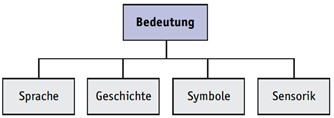
The written or spoken word plays a major role in the design of advertising messages. In the case of advertisements, the wording of the headline and advertising slogan in particular must be carefully analysed for their explicit and implicit meaning. In television and radio adverts, the tone of voice, the melody and the voice of the speaker also communicate a special (implicit) meaning to which the autopilot reacts very sensitively.
A particularly effective means of anchoring advertising messages in the customer's memory are Stories, as storytelling is one of the oldest forms of communication. People have always used stories to exchange meaningful information. For example, cultural knowledge was encoded in fairy tales and myths and passed on to the next generation (see Scheier/Held, 2018, p. 74 ff.; Fuchs, 2005, p. 61 ff.). Memory researchers assume that all events relevant to our lives are stored in what is known as autobiographical memory in the form of episodes or stories. They can be retrieved from our long-term memory into our consciousness as inner images (images) and have a significant influence on our perceptions and behaviour (see Hüther, 2011). This »works« particularly well if the personal stories were experienced as very emotional, such as the first day of school, first love, a special professional success or the loss of a loved one (cf. Fuchs, 2018, p. 121 ff.). This makes the importance of emotional stimuli comprehensible for the design of effective advertising messages. The stories of others told in adverts can also have a strong emotional impact on consumers, as they sometimes unconsciously empathise with the stories of others. For example, a commercial for the handkerchief brand Tempo told a short story with a father and son sledging and the claim „I feel strong with you“. And an older advert from Merci told the story of a married couple from getting to know each other to the wedding and the birth of their children.
Other efficient carriers of advertising messages are Symbols. They have also played a major role in human communication for a very long time. Our ancestors recorded many events in the form of symbols in order to make them accessible to subsequent generations. Due to their conciseness, symbols can implicitly communicate a multitude of culturally learned meanings in a very short time and trigger immediate behavioural programmes. The automatic behaviour-controlling effect of symbols can be illustrated using the example of a red traffic light: without thinking, it causes drivers to brake. In marketing, such effects have been proven, for example, with red discount symbols on price perception. However, many symbols used in advertising messages also have a very subtle and unconscious effect. For example, when looking at the Beck's advert, very few consumers think about the fact that the three-master that appears again and again is a symbol of adventure or that the lighthouse shown in the Jever advert is a symbol of origin (Figure 2). This shows that the symbols used and implicitly charged with meaning can effectively convey the positioning of brands in the minds of consumers. The protagonists depicted in advertising can also have a symbolic character: Thomas Gottschalk, for example, ideally conveyed Haribo's brand values of authenticity, cheerfulness and uncomplicatedness through his well-known personality among children and adults.

The use of suitable sensory codes is the fourth way to achieve the intended communication effects. This refers to all the stimuli that can be perceived by the human senses and are concealed in an advertising message. On the visual level, the design of images, colours and shapes conveys a specific meaning. The effect of key colours on brand identification is particularly impressive. For example, many consumers can automatically assign the colours shown in Figure 3 to the correct brand. However, colours can also convey meanings that are anchored in consumers' subconscious due to cultural characteristics. Black can appear classy, white symbolises lightness and pastel shades stand for wellness. In the advertising design of electronic media, acoustic stimuli can also communicate subconscious meanings that steer perception in a specific direction. For example, the sounds often used in advertising when pouring beer convey its freshness and can awaken an unconscious desire. Sensory stimuli have a stronger effect on the brain the more senses are stimulated simultaneously (multisensory amplification effect). However, the desired effect can only be achieved if the same meaning is conveyed via all the senses.


Additional material for the individual chapters:
3-2: Telecoms advertising - importance of mirror neurons for emotional reactions
3-4: Measuring implicit attitudes using the implicit association test (IAT)
3-6: Subjective perception: Are two tables identical or not?
3-7: The eye eats too: Visual perception influences our feeling of hunger
3-8: Febreze: Importance of habitualised decisions for marketing
4-2: Operationalisation and measurement of the environmental orientation of EU citizens
4-5: Screening questionnaire for the realisation of a predefined sample
4-6: Conception of an interview guide for a qualitative survey
4-7: Observation of individual eating behaviour in the „restaurant of the future“
4-8: Product positioning: Positioning a smartphone brand in the competitive environment
4-9: Testing the preference effect of smoothie properties using choice-based conjoint analysis
7-1: Kindle Fire - Influencing the perception of net benefit through advertising
7-2: Determining the optimal electricity tariff using choice-based conjoint analysis
7-4: Influencing perceived price favourability through umbrella pricing
7-7: High attractiveness of private financing and leasing offers for cars
8-1: Product positioning: Code analysis of the brand presence of two sparkling wine brands
8-12: Advertising impact analysis of digital communication tools
8-3: The power of megatrends and the future of safety and quality
8-5: Guerrilla communication: using a neo-Nazi march for a good cause
8-7: Integrated communication using the example of the Hypoxi brand
You are currently viewing a placeholder content from Instagram. To access the actual content, click the button below. Please note that doing so will share data with third-party providers.
More InformationYou are currently viewing a placeholder content from YouTube. To access the actual content, click the button below. Please note that doing so will share data with third-party providers.
More Information


Study Service Centre
+49 3631 420-222
House 18, Level 1, Room 18.0105