


Marketing textbook, chapter 9
Distribution policy → Acquisition-based distribution → Direct distribution channels → Company-owned distribution channels (section 9.2.2.1)
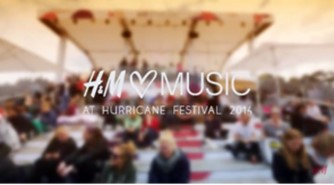
The Swedish fashion group Hennes & Mauritz installs pop-up stores at music festivals to strengthen brand loyalty in the direct environment of the target group.
The Swedish fashion group H&M uses the principle of pop-up stores and sells its „H&M Loves Music“ collection at festivals and open-air concerts worldwide via this type of sales outlet. For example, visitors to the Hurricane Festival 2014 were able to design their own textiles in an H&M pop-up store, get a professional make-up or a non-permanent tattoo in the „fresh'n'up area“, have photos taken and printed directly onto T-shirts in the „shoot'n'print area“ and buy the latest festival outfit in the „store area“. To complete the festival experience, guests could relax in the „H&M Loves Music Lounge“. This sales concept was also implemented in other countries, e.g. at the Afisha Picnic Music Festival 2014 in Moscow, the One Love Festival 2014 in Istanbul, the Roskilde Festival 2013, the Tomorrowland Festival 2013 in Boom, Belgium, and at other events in Montreal, Paris and other locations. In some cases, recycling campaigns are also included, where used clothing can be exchanged for new, sometimes individually designed pieces.
The distribution concept is combined with the promotion of up-and-coming artists or a festival sponsorship (see section 8.2.3.3). Depending on the design of a pop-up store, there can therefore be a close connection between brand communication and distribution, whereby in the case of H&M, the emotional festival experiences can also be transferred to the brand, thereby strengthening brand recall and brand loyalty.

Additional material for the individual chapters:
3-2: Telecoms advertising - importance of mirror neurons for emotional reactions
3-4: Measuring implicit attitudes using the implicit association test (IAT)
3-6: Subjective perception: Are two tables identical or not?
3-7: The eye eats too: Visual perception influences our feeling of hunger
3-8: Febreze: Importance of habitualised decisions for marketing
4-2: Operationalisation and measurement of the environmental orientation of EU citizens
4-5: Screening questionnaire for the realisation of a predefined sample
4-6: Conception of an interview guide for a qualitative survey
4-7: Observation of individual eating behaviour in the „restaurant of the future“
4-8: Product positioning: Positioning a smartphone brand in the competitive environment
4-9: Testing the preference effect of smoothie properties using choice-based conjoint analysis
7-1: Kindle Fire - Influencing the perception of net benefit through advertising
7-2: Determining the optimal electricity tariff using choice-based conjoint analysis
7-4: Influencing perceived price favourability through umbrella pricing
7-7: High attractiveness of private financing and leasing offers for cars
8-1: Product positioning: Code analysis of the brand presence of two sparkling wine brands
8-12: Advertising impact analysis of digital communication tools
8-3: The power of megatrends and the future of safety and quality
8-5: Guerrilla communication: using a neo-Nazi march for a good cause
8-7: Integrated communication using the example of the Hypoxi brand
You are currently viewing a placeholder content from Instagram. To access the actual content, click the button below. Please note that doing so will share data with third-party providers.
More InformationYou are currently viewing a placeholder content from YouTube. To access the actual content, click the button below. Please note that doing so will share data with third-party providers.
More Information


Study Service Centre
+49 3631 420-222
House 18, Level 1, Room 18.0105