


Marketing textbook, chapter 8
Communication policy → Planning and decision-making process for an advertising campaign → Determining the advertising media and advertising materials → Selected advertising media (section 8.3.6.3)
In 2020, the Otto Group launched its most successful Christmas campaign since its market launch. In addition to traditional advertising on television and online video adverts, the company increasingly relied on DOOH (Digital-Out-Of-Home) adverts for this campaign.
As with Bahlsen, Weischer.JvB was responsible for the digital poster adverts in collaboration with the media agency bpn. The Christmas 2020 campaign was themed „Home Nights“ and was intended to emphasise that no matter „who“ or „how“ you spend Christmas with, the festive season has a home, and it is always your own. Due to the ongoing coronavirus pandemic and the resulting uncertain plans for Christmas, Otto was able to tap into current events and the minds of its target group.
In addition to attracting emotional attention, the campaign was intended to encourage consumers to buy; the digital display boards with real-time customisation in particular offered the appropriate incentive to buy. Tailored to the relevant target group, the screens could be adapted to current events, the weather, the time and the location of the digital display. With outdoor advertising alone, the company achieved 230 million contacts through innovative and dynamically customised advertising. Thanks to the DOOH adverts, an advertising recall of 44% was created among the target group and the company increased its brand awareness to 41% (cf. Weischer.media, 2020).
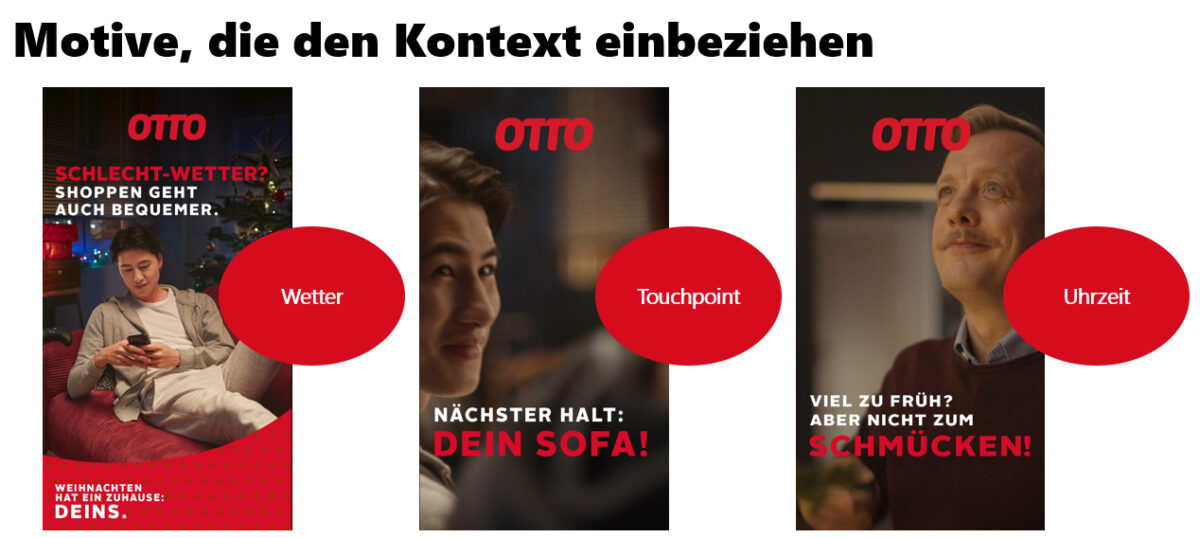
Three advertising motifs from OTTO to illustrate contextual marketing, based on the factors weather, touchpoint (location) and time.
The image shows three vertical advertising banners next to each other, each connected by a red oval with the corresponding context factor:

Additional material for the individual chapters:
3-2: Telecoms advertising - importance of mirror neurons for emotional reactions
3-4: Measuring implicit attitudes using the implicit association test (IAT)
3-6: Subjective perception: Are two tables identical or not?
3-7: The eye eats too: Visual perception influences our feeling of hunger
3-8: Febreze: Importance of habitualised decisions for marketing
4-2: Operationalisation and measurement of the environmental orientation of EU citizens
4-5: Screening questionnaire for the realisation of a predefined sample
4-6: Conception of an interview guide for a qualitative survey
4-7: Observation of individual eating behaviour in the „restaurant of the future“
4-8: Product positioning: Positioning a smartphone brand in the competitive environment
4-9: Testing the preference effect of smoothie properties using choice-based conjoint analysis
7-1: Kindle Fire - Influencing the perception of net benefit through advertising
7-2: Determining the optimal electricity tariff using choice-based conjoint analysis
7-4: Influencing perceived price favourability through umbrella pricing
7-7: High attractiveness of private financing and leasing offers for cars
8-1: Product positioning: Code analysis of the brand presence of two sparkling wine brands
8-12: Advertising impact analysis of digital communication tools
8-3: The power of megatrends and the future of safety and quality
8-5: Guerrilla communication: using a neo-Nazi march for a good cause
8-7: Integrated communication using the example of the Hypoxi brand
You are currently viewing a placeholder content from Instagram. To access the actual content, click the button below. Please note that doing so will share data with third-party providers.
More InformationYou are currently viewing a placeholder content from YouTube. To access the actual content, click the button below. Please note that doing so will share data with third-party providers.
More Information


Study Service Centre
+49 3631 420-222
House 18, Level 1, Room 18.0105