


Marketing textbook, chapter 4
Market research → Decision problems in the context of data collection → Measurement theory basics (Chapter 4.2.2)
The idea for the „brand check“ was developed by Westdeutscher Rundfunk, but this format has also been broadcast on ARD for some time now, achieving a considerable quantitative reach. The first programme, the so-called „Lidl Check“, was watched by more than six million viewers and was followed by reports on McDonald's, Coca Cola, Apple and TUI, among others. However, the quality criteria for measurement largely fall by the wayside with this format.
In 45 minutes, a well-known brand is critically analysed with regard to the purchasing criteria relevant to consumers. To this end, experts are interviewed and the respective company has its say, but the focus is on capturing consumer opinion as realistically as possible in sound and vision. The fact that the quality of the results - at least for some of the criteria examined - is questionable is demonstrated by the reaction of a company spokesperson to the TUI brand check: „We consider the TUI brand check to be biased. In many respects, it gives a completely false picture of us as a quality and market leader.“
There is no doubt that the „Markencheck“ programme's approach is seriously flawed when it comes to assessing the sensory quality of the food and luxury food brands tested. Binding, scientifically proven standards for measuring the sensory quality of foods, which must be adhered to in any serious empirical study, are irresponsibly ignored in the programme. The three basic quality criteria of any measurement, namely objectivity, reliability and validity, are not adequately taken into account, as can be seen from the example of the McDonald's check.
The sensory acceptance test for hamburgers and French fries from McDonald's, Burger King and Joe Champs, which was broadcast on ARD, was carried out as a so-called „Central Location Test“ (CLT) in Cologne city centre with just over 100 randomly selected passers-by, first as a blind test and then as a marked test, with the products being evaluated by the number of French fries forks handed out (see Figure 1).
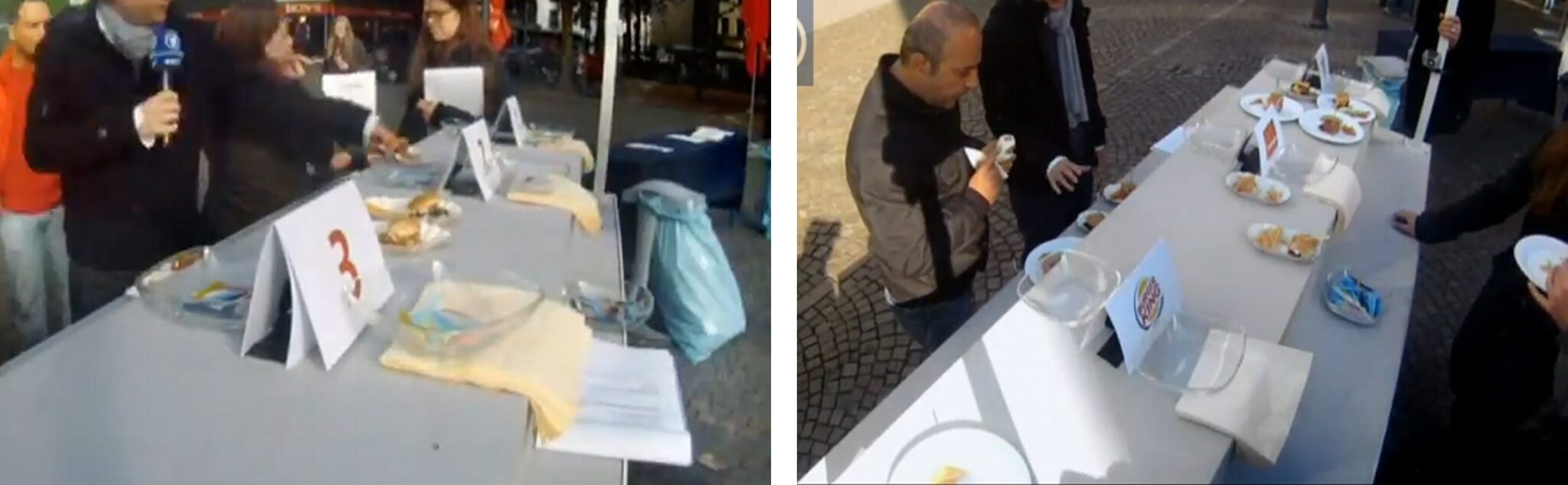
Left photo:
You can see a group of people at a table. A reporter with a microphone (blue and white ARD logo) is talking to the participants. On the table are white stands with red numbers (the number „3“ is clearly recognisable). In front of the stands are burger halves on neutral plates as well as napkins and information sheets. In the background you can see a rubbish bin with a blue bag and passers-by in the city.
Right photo:
This photo shows the stand from a slightly elevated perspective. A man is standing at the table and examining or tasting one of the samples. Several samples are spread out on the table on small white paper plates. The surrounding area shows cobblestones, suggesting a market square or pedestrian zone.
The Objectivity of a measurement is only guaranteed if different people who measure the same empirical facts independently of each other arrive at identical results. The scenes broadcast prove beyond doubt that the objectivity of the measurements taken in the McDonald's brand check, for example, is not given because the test subjects influenced each other and the behaviour of the test leaders also impaired the quality of the results.
The Reliability or reliability of a measurement is only given if identical measured values are obtained when the same facts are measured repeatedly, i.e. the measurement must be free of random errors. An important prerequisite for reliability is the constancy of the test conditions. However, the external influences (e.g. eating temperature) were not kept constant in the McDonad's brand check, as the test products, for example, were procured from branches in the neighbourhood and had different eating temperatures and consistencies depending on the time elapsed until tasting. Anyone who has ever eaten a bag of chips on the street or ordered a pizza from a delivery service will be familiar with this problem.
The Validity The validity of a measurement is only guaranteed if it measures exactly the empirical facts that the researcher claims to measure, i.e. the measurement must be free of systematic errors. An important prerequisite for the validity of a measurement is that the results can be generalised, i.e. that the measurement results of the sample under consideration can be transferred to the population (external validity). The requirements for a representative sample (population validity) and a representative research context (situation validity) are not sufficiently met by either the McDonald's brand check or other brand checks.
The fact that the brand owners concerned did not publicly criticise these - and other - shortcomings with regard to the quality of the sensory quality measurements of their products can presumably be explained by the fact that they feared that the additional public discussion would cause even more damage to their brand than was already caused by the ARD programme. The damage to the image of the brands concerned is so high because many consumers trust the questionable results of the programme (see Figure 2), change their attitude towards these brands and ultimately base their purchasing decisions on them. Public television should therefore be asked to place more emphasis on the quality of the test equipment in future „Markencheck“ programmes and thus provide consumers with more reliable information about the sensory quality of the food and luxury food brands tested
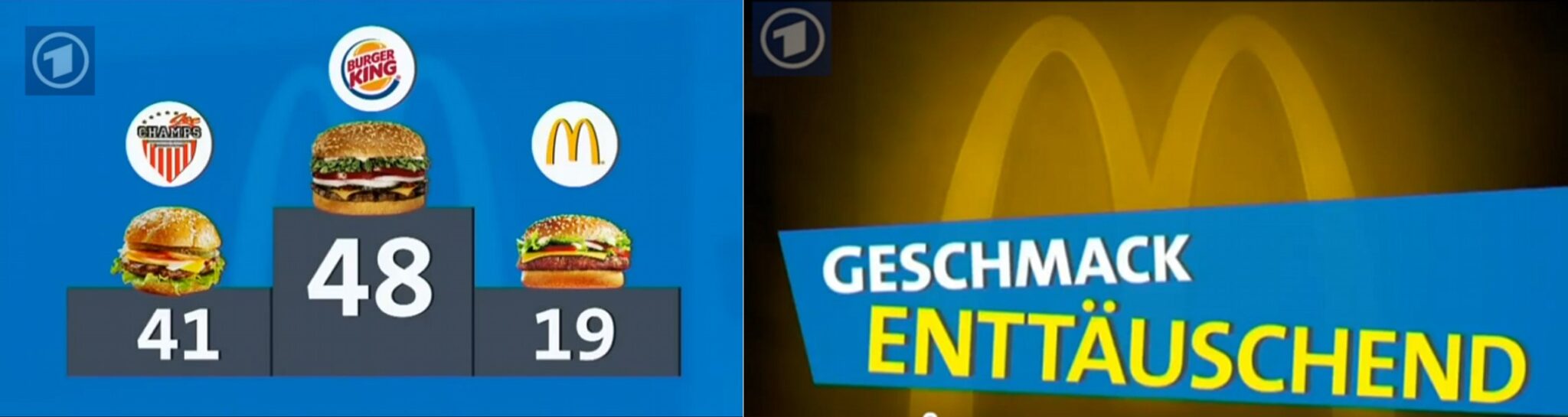
The picture is divided into two parts, which summarise the results of a TV report (ARD/WDR Markencheck):
Left half of the picture (winner's podium):
A classic pedestal with three steps is depicted against a blue background.
A burger and the respective company logo are shown above the number (preference for the product).
Right half of the picture (conclusion):

Additional material for the individual chapters:
3-2: Telecoms advertising - importance of mirror neurons for emotional reactions
3-4: Measuring implicit attitudes using the implicit association test (IAT)
3-6: Subjective perception: Are two tables identical or not?
3-7: The eye eats too: Visual perception influences our feeling of hunger
3-8: Febreze: Importance of habitualised decisions for marketing
4-2: Operationalisation and measurement of the environmental orientation of EU citizens
4-5: Screening questionnaire for the realisation of a predefined sample
4-6: Conception of an interview guide for a qualitative survey
4-7: Observation of individual eating behaviour in the „restaurant of the future“
4-8: Product positioning: Positioning a smartphone brand in the competitive environment
4-9: Testing the preference effect of smoothie properties using choice-based conjoint analysis
7-1: Kindle Fire - Influencing the perception of net benefit through advertising
7-2: Determining the optimal electricity tariff using choice-based conjoint analysis
7-4: Influencing perceived price favourability through umbrella pricing
7-7: High attractiveness of private financing and leasing offers for cars
8-1: Product positioning: Code analysis of the brand presence of two sparkling wine brands
8-12: Advertising impact analysis of digital communication tools
8-3: The power of megatrends and the future of safety and quality
8-5: Guerrilla communication: using a neo-Nazi march for a good cause
8-7: Integrated communication using the example of the Hypoxi brand
You are currently viewing a placeholder content from Instagram. To access the actual content, click the button below. Please note that doing so will share data with third-party providers.
More InformationYou are currently viewing a placeholder content from YouTube. To access the actual content, click the button below. Please note that doing so will share data with third-party providers.
More Information


Study Service Centre
+49 3631 420-222
House 18, Level 1, Room 18.0105